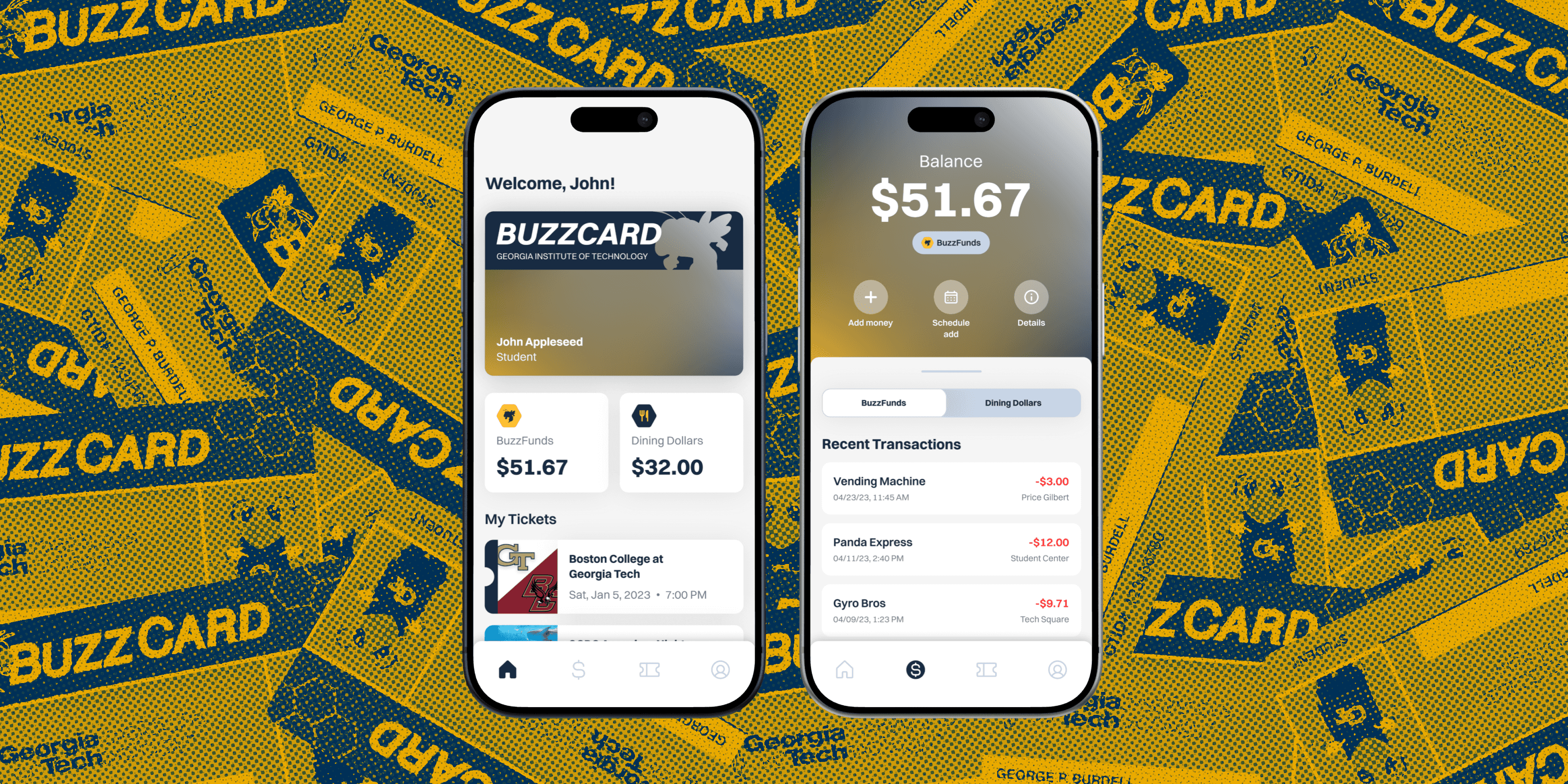
BuzzWallet

Exploring how access around Georgia Tech can be consolidated into one tool

TIMELINE

Jan 2023 - May 2023

ROLE

UX Design

User Research

Branding

TEAM

Self

Jason Lin

TOOLS

Figma

00

->

Setting the Scene

Providing context into our project and its overall focus

Project Overview

BuzzWallet is the result of a 10-week design bootcamp with Georgia Tech Bits of Good. This was a conceptual project where I collaborated with 1 other designer. The bootcamp had us tackle a prompt of our choice, which we decided to focus on the question:

What are problems facing Georgia Tech students that can be tackled through design?

the focus

For our project, we decided to focus on an aspect that all Georgia Tech students share regardless of year or major - possession of a Georgia Tech BuzzCard.

The Georgia Tech BuzzCard is the physical identification card that all Georgia Tech students possess. The BuzzCard mainly gives access to:

Campus Buildings & Rooms
Campus Funds
Campus Events
personal + peer experience

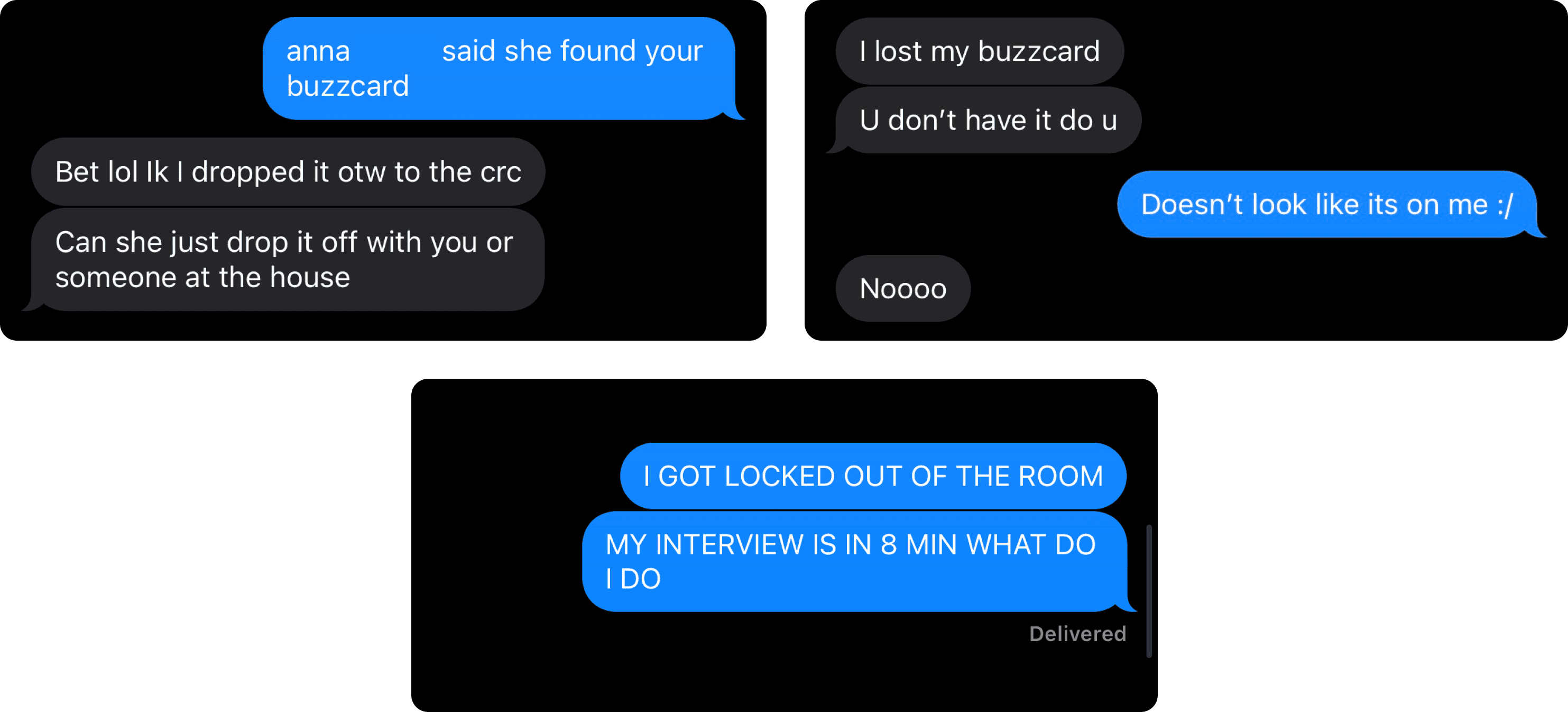
When it came to the BuzzCard, we started to think about our own personal experiences with the student ID card. We found there were instances where ourselves or peers had lost, left, or misplaced their BuzzCard.

It was clear that misplacing or losing a BuzzCard often led to emotional distress and cost users time and money to retrieve their BuzzCard.
initial inquiry

With an area of focus selected and observed personal pain points, we asked ourselves:

What and how can we improve the BuzzCard?

Solution

A Digital BuzzCard

Students can access their BuzzCard wherever and whenever. The BuzzCard can also be added to their device's mobile wallet for quicker access.

A Hub to Manage BuzzFunds

Students are able to manage campus funds in-app and use their funds through the digital BuzzCard in their device’s mobile wallet.

Easy Access to Campus Event Tickets

Students are able to acquire and view tickets in-app with the option to add them to their device’s mobile wallet for even faster access.

01

->

Problem Discovery

Conducting research and defining the problem

User Research

The research we conducted for the project was made through a survey sent out to students around campus. The use of a survey allowed us to reach a greater population of students on campus and gather insights from a wide range of students from undergraduate to graduate. Questions asked in this survey were related to functionality, frequency, and pain points associated with the BuzzCard.

Example Questions

How frequently do you use your BuzzCard?

How would you rate accessibility to your BuzzCard balance?

How would you rate your experience in acquiring tickets for campus events?

After surveying a total of 73 participants and interviewing 7 of those 73 participants, we grouped together quotes from users by topic and areas of concern. This allowed us to get a clear view of what area frustrations and friction were arising from.

From these quotes and from data gathered in the survey, we discerned three main pain points students were facing

01

Students prefer convenience when using their BuzzCard

Students are saying

“Mobile version of the BuzzCard would be so much easier”

“Put it on my phone!!”

02

Students have trouble accessing their Georgia Tech funds

Students are saying

“I never know where to load funds to my BuzzCard”

“I keep forgetting to bring my BuzzCard with me so I never really get to use my BuzzFunds”

03

Students find it difficult to acquire and access tickets for campus events

Students are saying

“Tickets are often in emails and they can be lost within my inbox.”

“Football season tickets are like a wild goose chase the website is literally awful”

Existing solutions

Soon after, we began taking a look at existing solutions within spaces related to the BuzzCard and its functions. We focused on the BuzzCard, EAccounts which is used to upload BuzzFunds, and existing Ticketing and Event pages. From here, we determined pros and cons of each platform and what could be improved.

User Flow

We then began mapping out a user flow that connected the various functions of the BuzzCard - including access to BuzzFunds and access to tickets. This allowed us to get a visual idea of how we were addressing student pain points and see how features would flow together.

We then began mapping out a user flow that connected the various functions of the BuzzCard - including access to BuzzFunds and access to tickets. The goal of this flow was to visualize and connect the multiple functions of the BuzzCard into a single streamlined experience — from ticket access to BuzzFunds management. By mapping this out, we identified potential friction points and ensured users could intuitively navigate between services.

The problem

In our initial problem discovery, students we talked to underlined a number of issues with the BuzzCard. Among the students we talked to, many shared a common complaint - students kept losing or leaving their BuzzCard at home.

The BuzzCard’s physical form and fragmented access across apps and websites limit its usability.

So then, the question became:

How can we redefine the BuzzCard to allow students to access its uses wherever and whenever all in one place?

02

->

Design Iteration

Finding our north star and iterating towards a solution

Design Goals

With a defined "How Might We" question and a better understanding of the problem space, we established three design goals that looked to address the three research insights we gathered:

01

Digitalize the BuzzCard

02

Create an easy-to-access stop for accessing and managing campus funds

03

Create a space to view and retrieve tickets for campus events

Global trends

In 2021, Apple announced that four states including Georgia would allow state IDs and driver's licenses to be added to the Apple Mobile Wallet. With an important piece of identification now being implemented into the mobile wallet, there has seemingly been a national and global shift towards the use of a digital wallet over a physical one. This is reflected in the growth of digital wallet transactions: 

In a 2023 study by Juniper Research, research found that the total value of digital wallets transactions will rise from $9 trillion in 2023 to surpass $16 trillion in 2028 - a growth of 77%.

Based on current and future trends regarding digital wallets, we began shaping our design direction for the BuzzCard around this movement away from the physical wallet.

Low-Fidelity

Based on our research, user flow, and the design goals we set for ourselves, we began working on a basic framework to support the intended functions. This allowed us to begin mapping nodes and features from our user flow.

Mid-Fidelity

Once we had completed our low-fidelity prototype, we moved into working on the mid-fidelity prototype - where we focused on bringing in graphical elements into the interface.

feedback + testing

To validate our design decisions, we ran three usability tests with participants drawn from our initial interviews and bootcamp mentors. Each participant was asked to complete core tasks — viewing their student ID, reloading BuzzFunds, and accessing a specific campus event ticket—while thinking aloud and explaining their decision-making.

Change 01 ->

Simplifying UI + Interactions

Based on feedback from our design mentors, we prioritized simpler UI over an accordion-style wallet UI.

Change 02 ->

Flattening the UI design

To better align with WCAG guidelines, we changed the UI from gradient heavy to flat white.

Change 03 ->

Adding navigation

Based on user feedback, we added a navigation bar in the final design to allow for easier navigation and screen awareness.

03

->

Final Design

Style Guide

In creating BuzzWallet’s identity, we looked to derive many elements from Georgia Tech motifs and its color palette – with changes made to ensure visual contrast between colors.

Final Screens

04

->

Thoughts + Reflection

Final thoughts and reflecting on our work

presenting our final solution

At the end of the bootcamp, we were able to present our projects in front of a crowd of students from the Bits of Good community and the greater Georgia Tech student population. We received an overwhelming amount of feedback from students with some saying:

“I would literally download this”

“Georgia Tech needs to get this built”

in this picture in spirit 💔
given more time

After being able to complete and present BuzzWallet, I felt that this was one of the most rewarding projects I have had the pleasure of working on. From being able to continue growing my skillset as a designer to learning what works best in a group setting, I felt that I was able to grow in a holistic manner. Despite this, I also felt there were some areas during the project that I felt could be changed or be approached differently.

Expanded user group

Much of our research into the use of the BuzzCard for this project was focused on students due to the ease of access to this population. Given more time however, I would've liked to see a greater focus on faculty - from professors to janitorial staff - who use the BuzzCard. I think this inclusion of users would've greatly altered some of the design decisions made as well as introduce new ones.

conduct more tests

Most of our feedback towards the end was from our bootcamp mentors, less so from users themselves. With more time, I would've liked to have been able to conduct tests with a wider population of Georgia Tech students.

thoughts + reflection
design decisions -> solving the problem

At the end of the day, design decisions need to be steps towards solving the problem we’re seeking to solve.

communicate, communicate, communicate

Life as student can sometimes get in a way especially in a side project such as this. It was very important to both my partner and I that we make sure to update one another with any potential blockers over the course of the project.