ParkMobile
Increasing confidence in drivers' parking search through the ParkMobile app
TIMELINE
Aug 2025 - Dec 2025
SKILLS
Research
Product Design
Prototyping
TEAM
Self
Jennifer Chandran
Anjali Singh
Alice (Xinran) Yu
Overview
This was a sponsored project in partnership with ParkMobile and it's parent, Arrive. This project explores ways to increase early user engagement with the ParkMobile app and address driver frustrations with paid parking. The project was completed over 16 weeks where I collaborated with three other students. ParkMobile's UX Research lead acted as a shepherd and point of contact for the project.

Setting the Scene
the urban parking problem
Urban parking is broken.
82%
of drivers identify parking as their top urban stressor (ParkMobile 2023)
75%
of drivers say poor parking infrastructure discourages them from going out (ParkMobile, 2024)
Cities think the solution is more parking. It's not.
The city of Atlanta is the biggest offender of this misguided belief. In Downtown Atlanta…
25%
of the Downtown Atlanta area is devoted to parking
Only 42%
of downtown parking is actually utilized - well below national averages
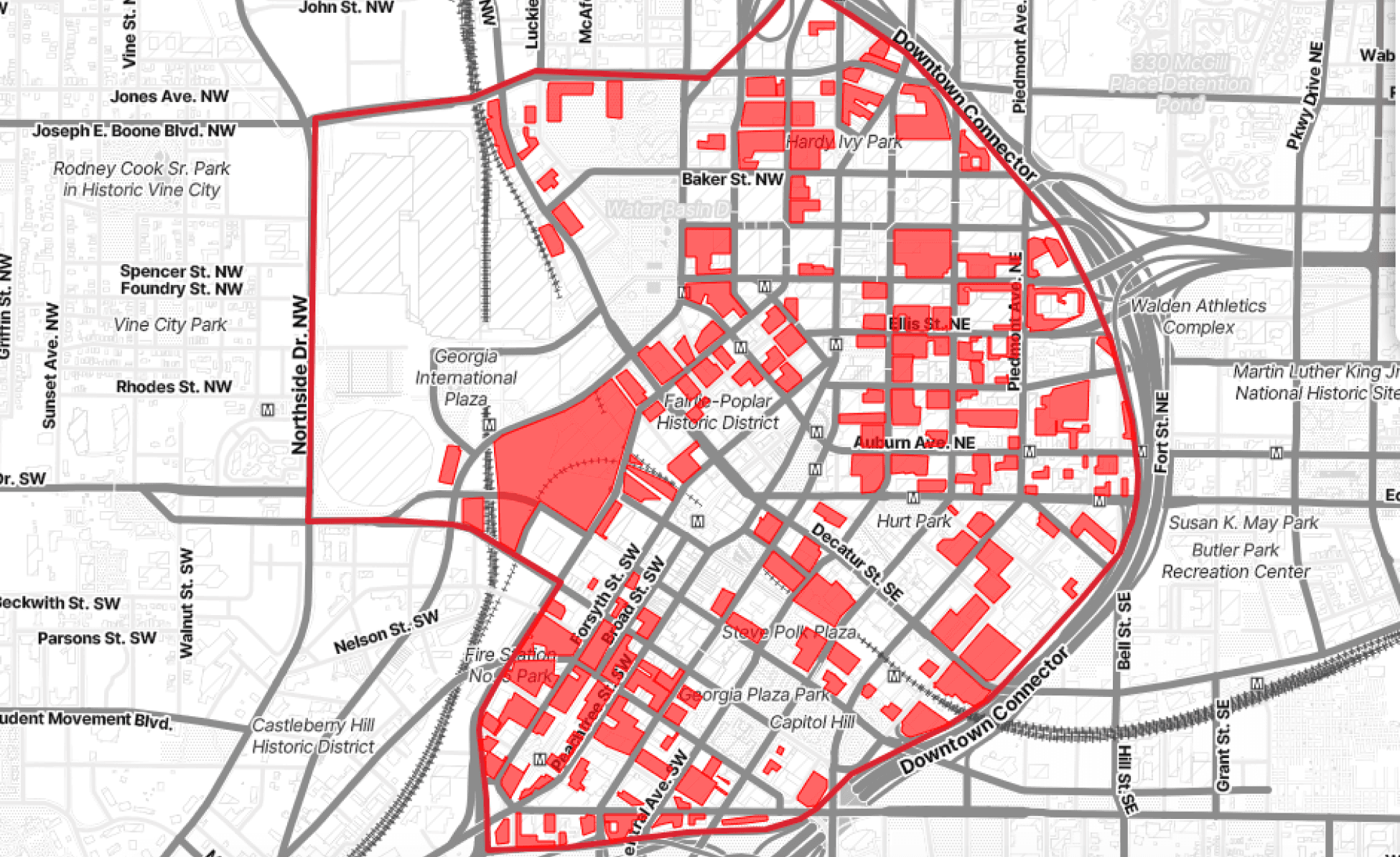
The issue with parking isn’t quantity - it’s about visibility and certainty.
parkmobile
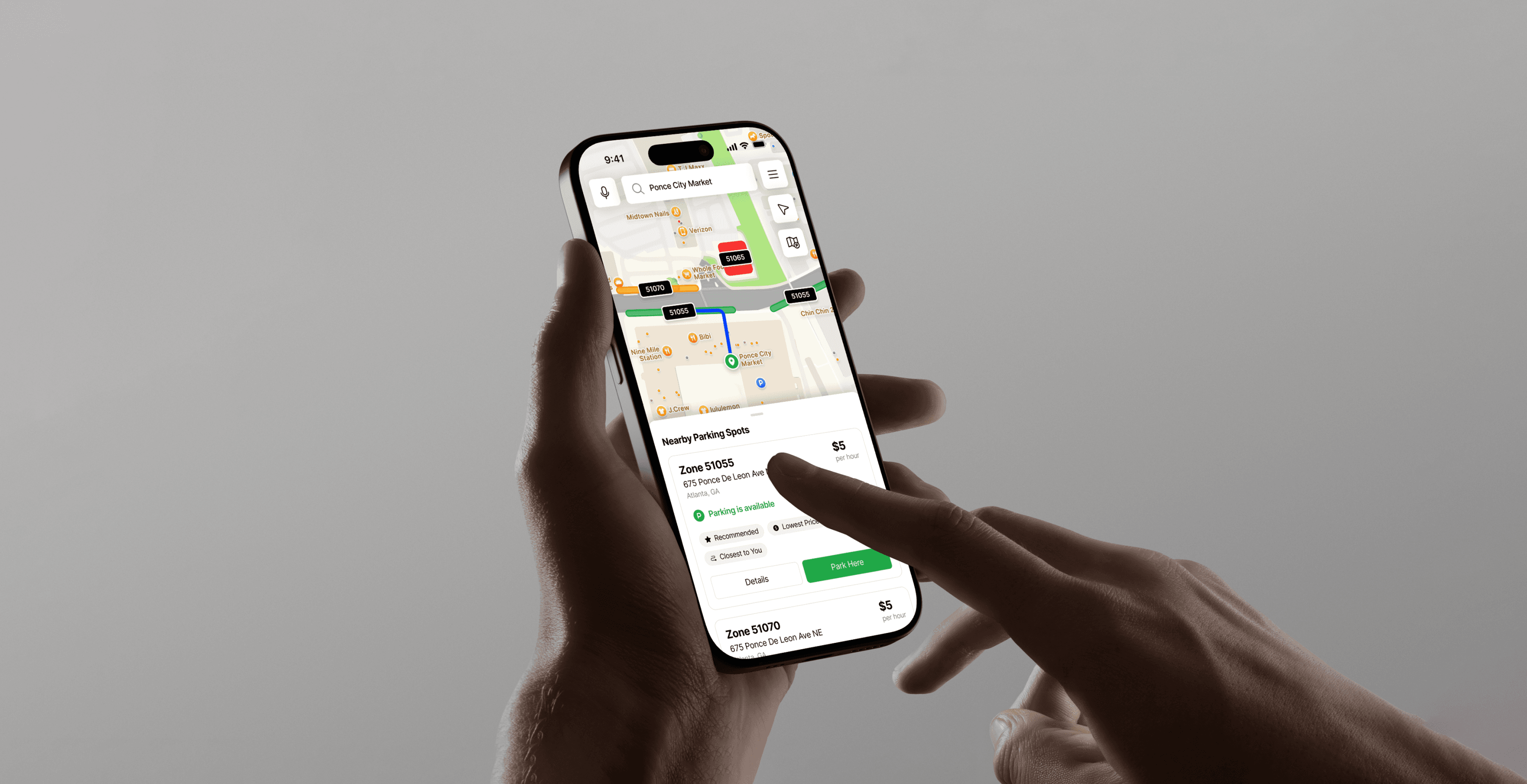
Enter ParkMobile.
ParkMobile is North America's leading parking platform with over 65+ million users across 700+ cities. ParkMobile addresses the urban parking problem through it's two core features - Parking Search & Reservation and Contactless Parking Payment.
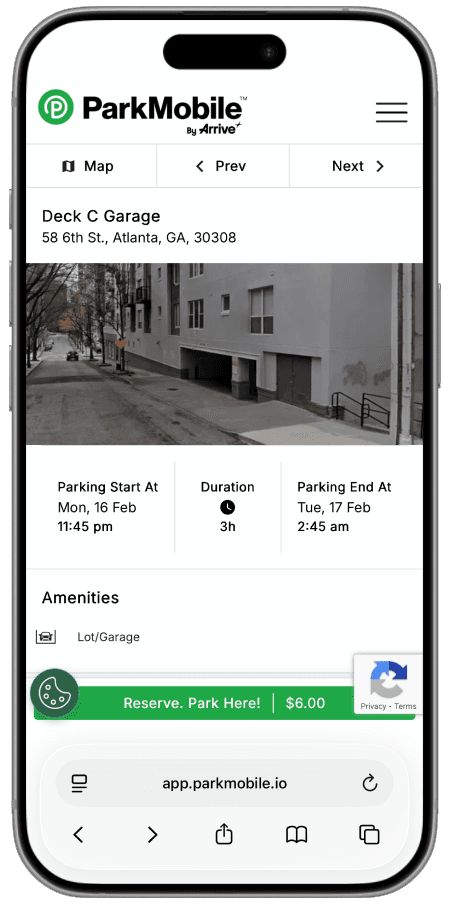

Parking Search + Reservation
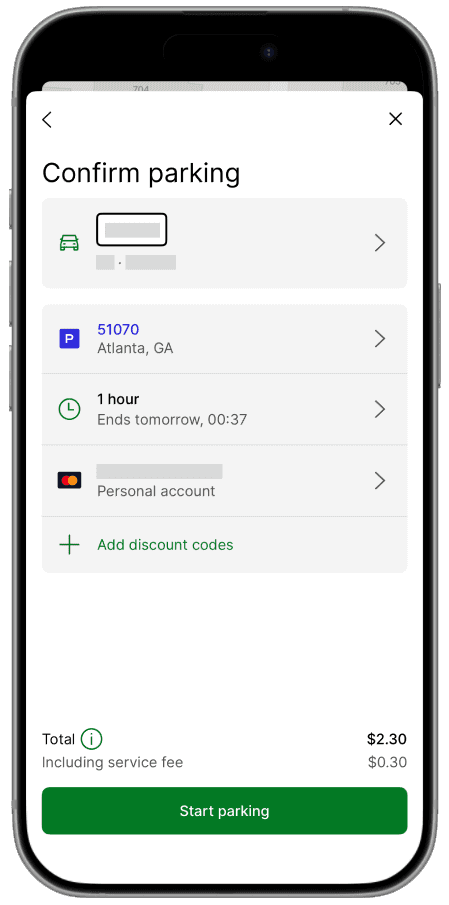

Contactless Parking Payment
the problem
However, ParkMobile came to us with an alarming statistic.

Most ParkMobile users only interact for 28 seconds on average - and only at the payment stage, revealing a gap between ParkMobile’s features and real user behavior.
the question
Thus, we asked ourselves

How might we help drivers make more confident parking decisions by increasing clarity and engagement with ParkMobile throughout their driving journey?
the solution
We tackled our how might we question with two design proposals:
Pre-Parking Planning
Drivers can search their destination before beginning their trip to preview nearby parking zones. This allows them to view pricing, amenities, and parking availability so they can plan where to park before entering busy areas.
Parking Guidance
Our solution introduces an AI Parking Assistant that when prompted, recommends locations based on availability, pricing, distance, and other preferred factors.
why this matters
At the end of the day, why does this all matter? For Arrive and ParkMobile, this is an opportunity to own the end-to-end driving experience beyond just payments. For stakeholders such as drivers, cities, and businesses, it's an opportunity to reduce stress, traffic, and customer drop off due to parking concerns.

Arrive + ParkMobile
Own the end-to-end driving experience beyond payments

Drivers
Reduce parking stress and makes planning easier

Cities
Cut down on unnecessary traffic and emissions

Businesses
Reduce customer drop-off due to parking concerns
project timeline
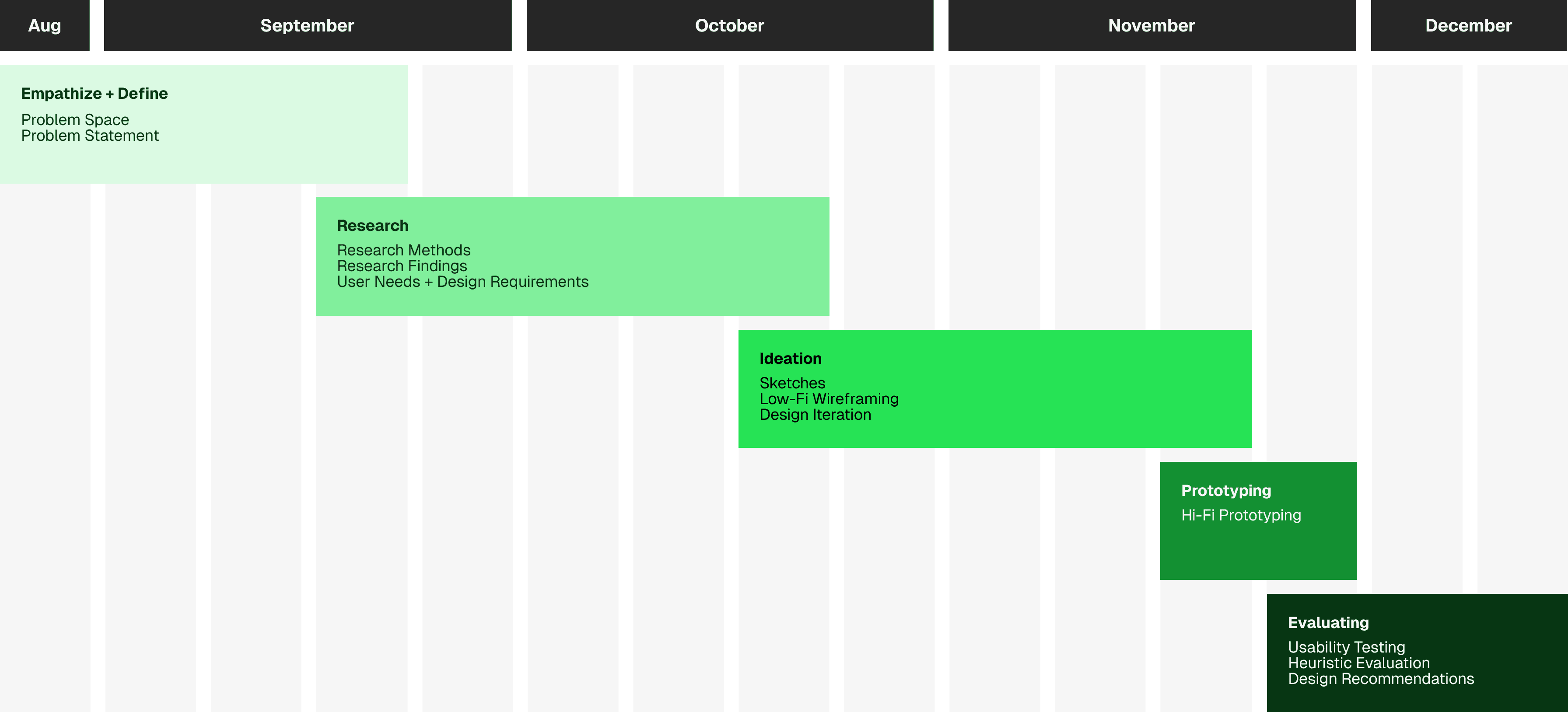
The group then scoped out the next 16 weeks for the project, breaking apart the project into phases - from Empathizing and Defining the problem space to Ideation and then on to Evaluation.
Research
research objective

We started by understanding how drivers behave and feel about parking and parking apps.
research methodology
For our research process, we took a holistic approach - using both both qualitative and quantitative methods from interviews to surveys in order to understand driver behavior and feelings.

Semi-Structured Interviews
14 interviews

Competitive Analysis
ParkMobile, SpotHero, PayByPhone

Secondary Review
9 sources

Survey
50+ responses

Task Analysis
ParkMobile
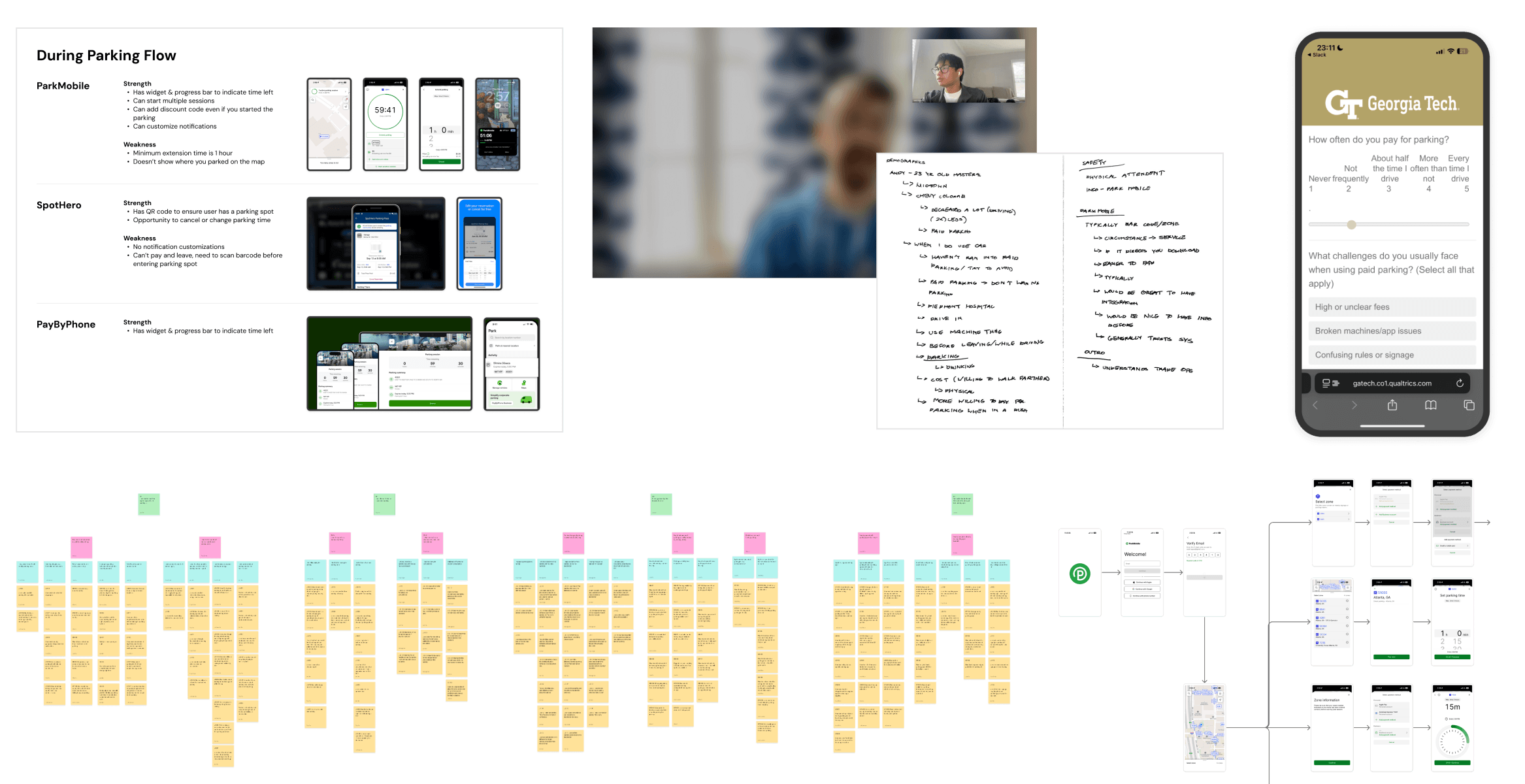
Artifacts from our research
leveraging ai as a researcher
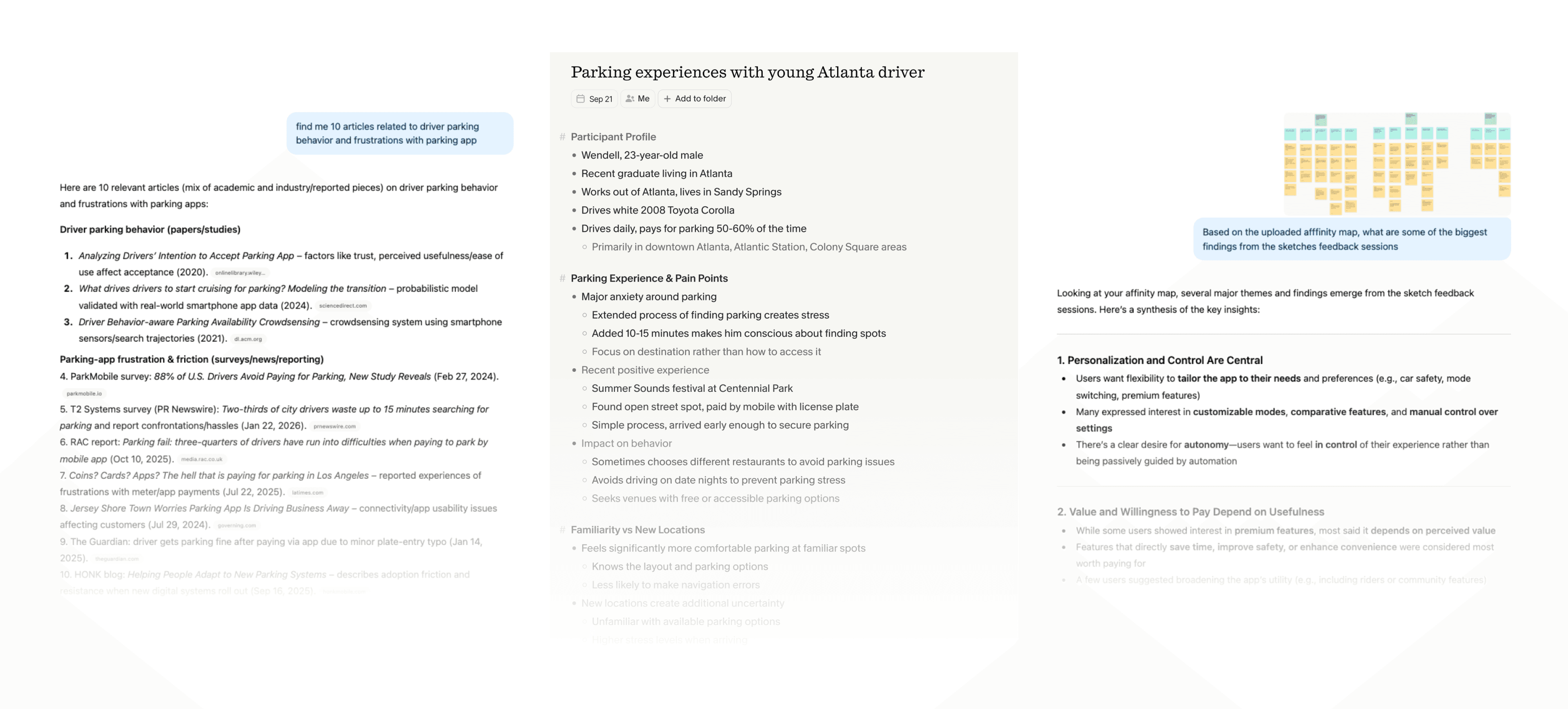
Throughout our user research process, we leveraged AI tools to act a second user researcher on the team. We used tools like Chat and Granola to supplement notes from user interviews, have agents review and pull up research articles, and analyze affinity maps.
research findings
Our research led us to these four findings ->
01

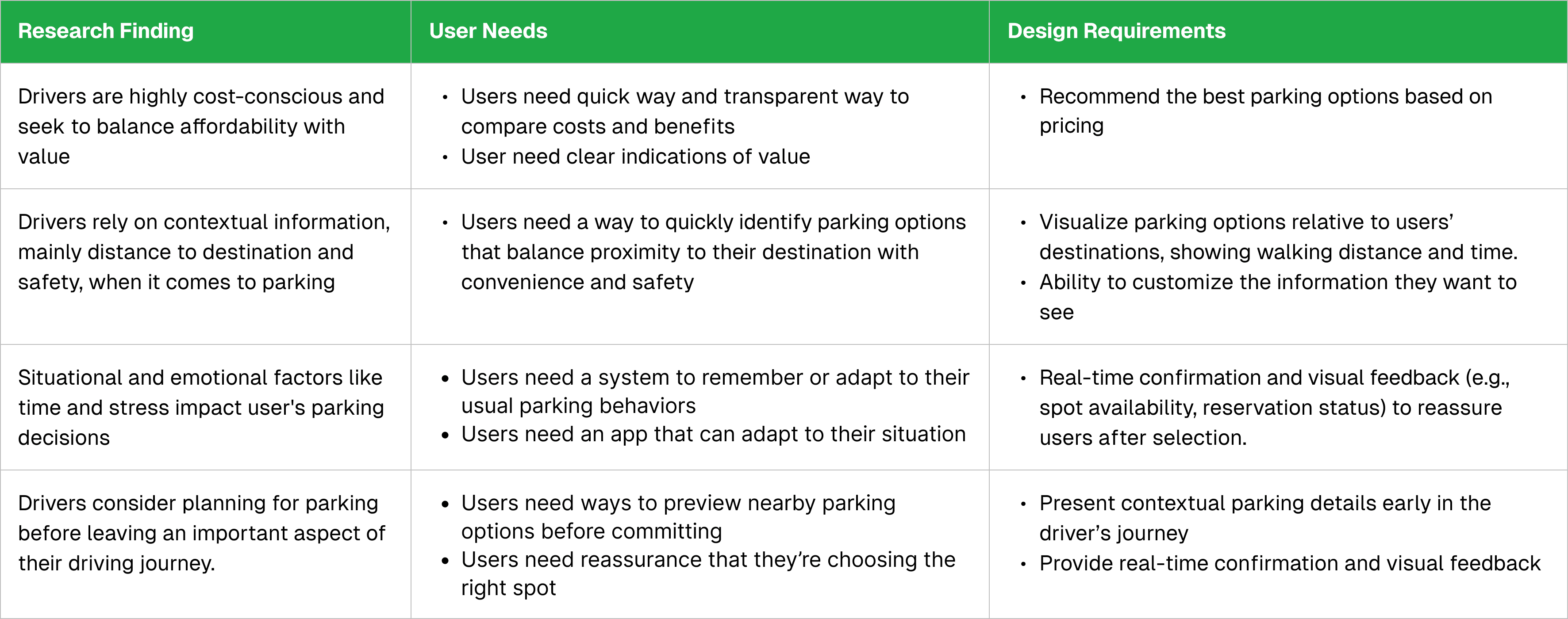
Drivers are highly cost-conscious and seek to balance affordability with value
02

Drivers rely on contextual information, mainly distance to destination and safety, when it comes to parking
03

Situational and emotional factors like time and stress impact user's parking decisions
04

Drivers consider planning for parking before leaving an important aspect of their driving journey.
current shortcomings
In addition, we identified the following shortcomings with the current ParkMobile app.

01
Current app offers little to no context around parking
02
Search is based on addresses, rather than landmarks
03
Parking selection lacks filtering for lot type, safety, or amenities
04
Features such as reservation and parking details are only available in the web version
research summary

Drivers don’t think about parking just in terms of payment. It’s also a context and safety driven decision that starts earlier than ParkMobile supports.
USER NEEDS & design requirements
Each finding was then translated into a set of user needs. Based upon the user needs, we created design requirements were created for each finding. These requirements would help guide our next phase in the project with design iteration.
Design Iteration
ideation process
Our ideation took the following process. We began with initial sketches around the design requirements laid out in our research phase. From there, we gathered feedback from ParkMobile's UXR lead. This conversation led to further sketch explorations. The group then voted on what concepts to move forward based on how they fit into our requirements.
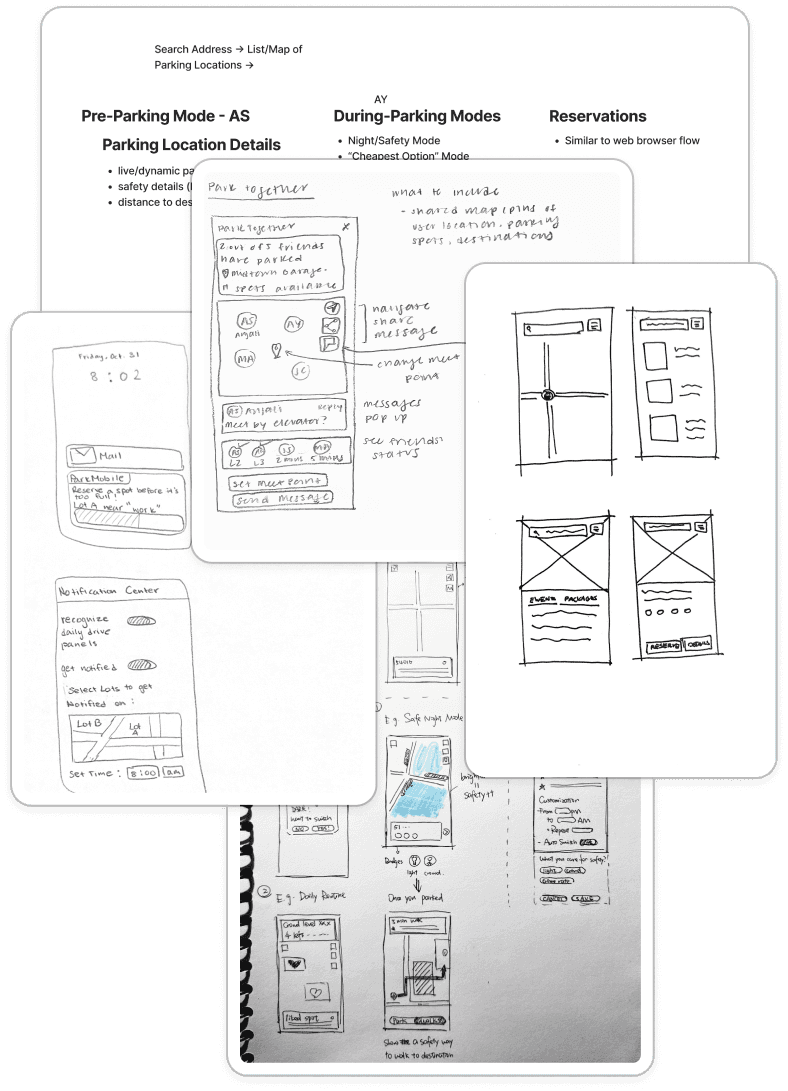
01
Initial Sketches
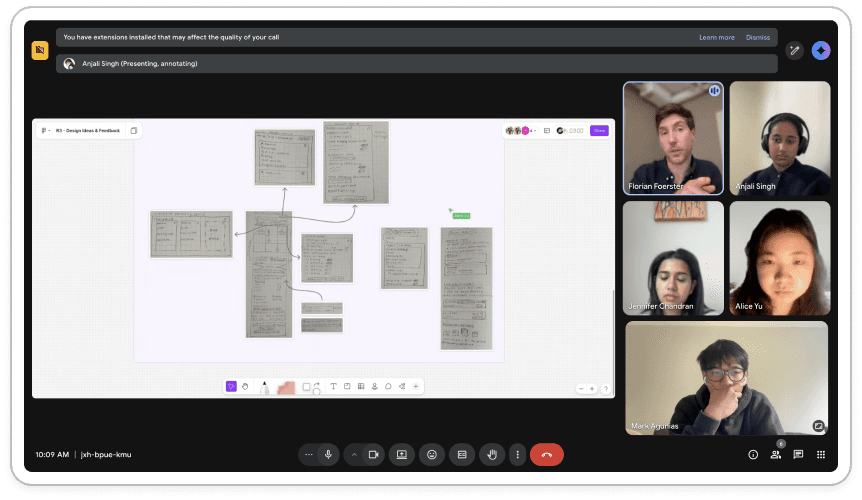
02
Sponsor Discussion
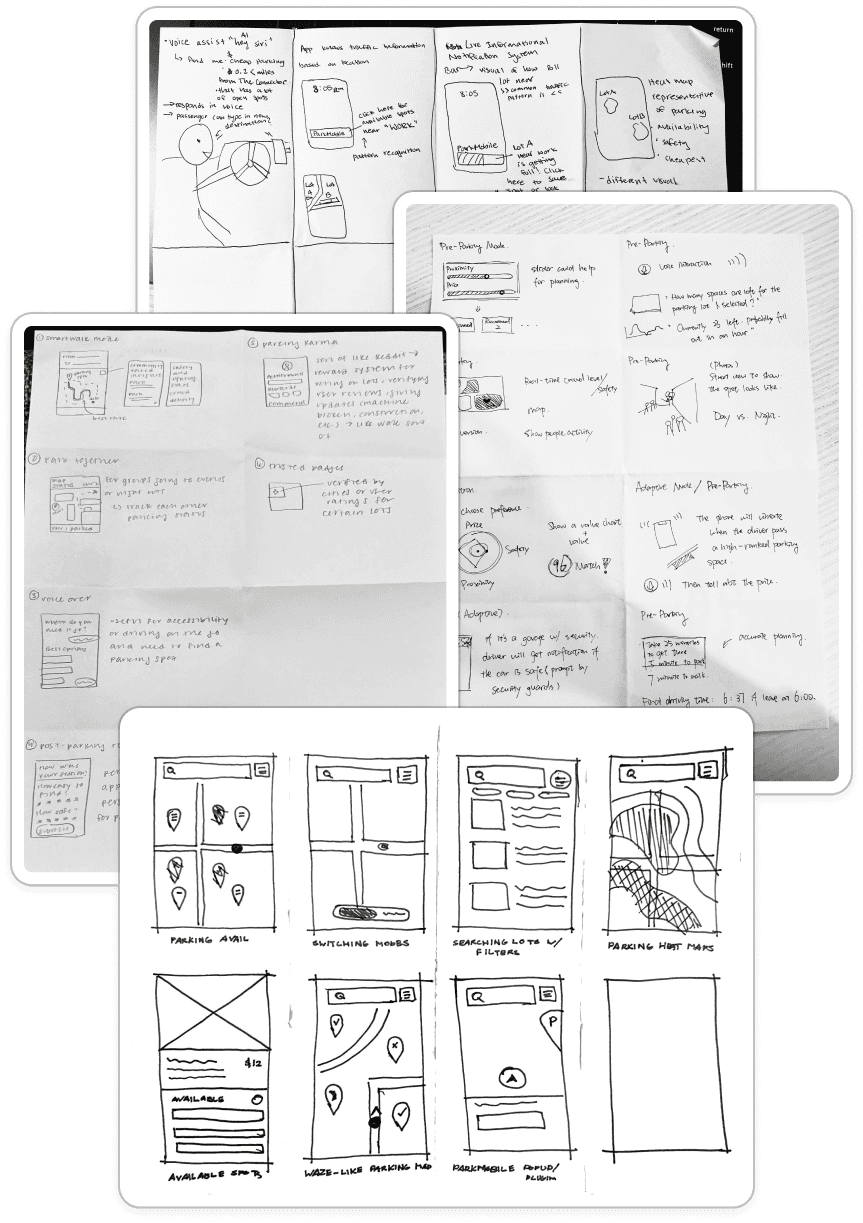
03
Further Sketch Exploration
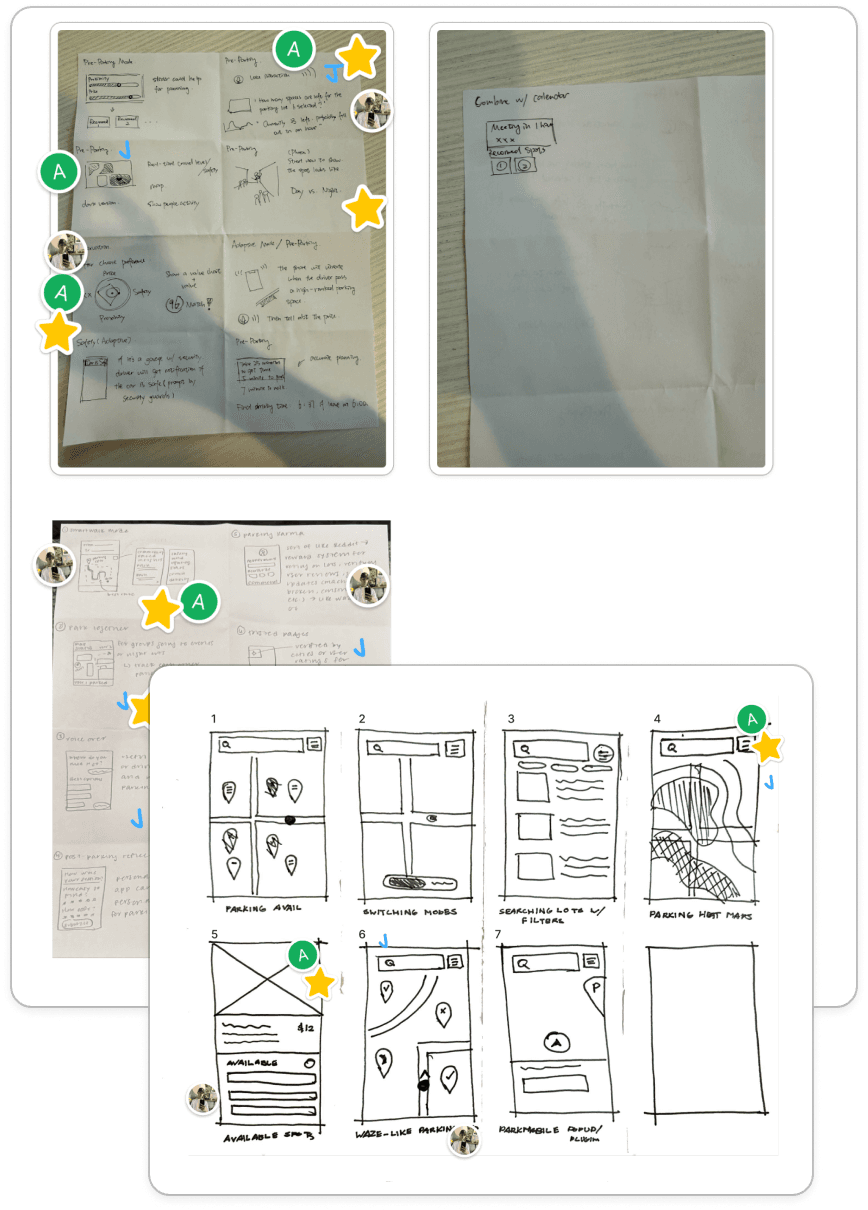
04
Concept Selection
sketches
With our sketches, we explored ideas around three ideas - Pre-Parking Planning, Parking Companions, and Adaptive Parking Modes.
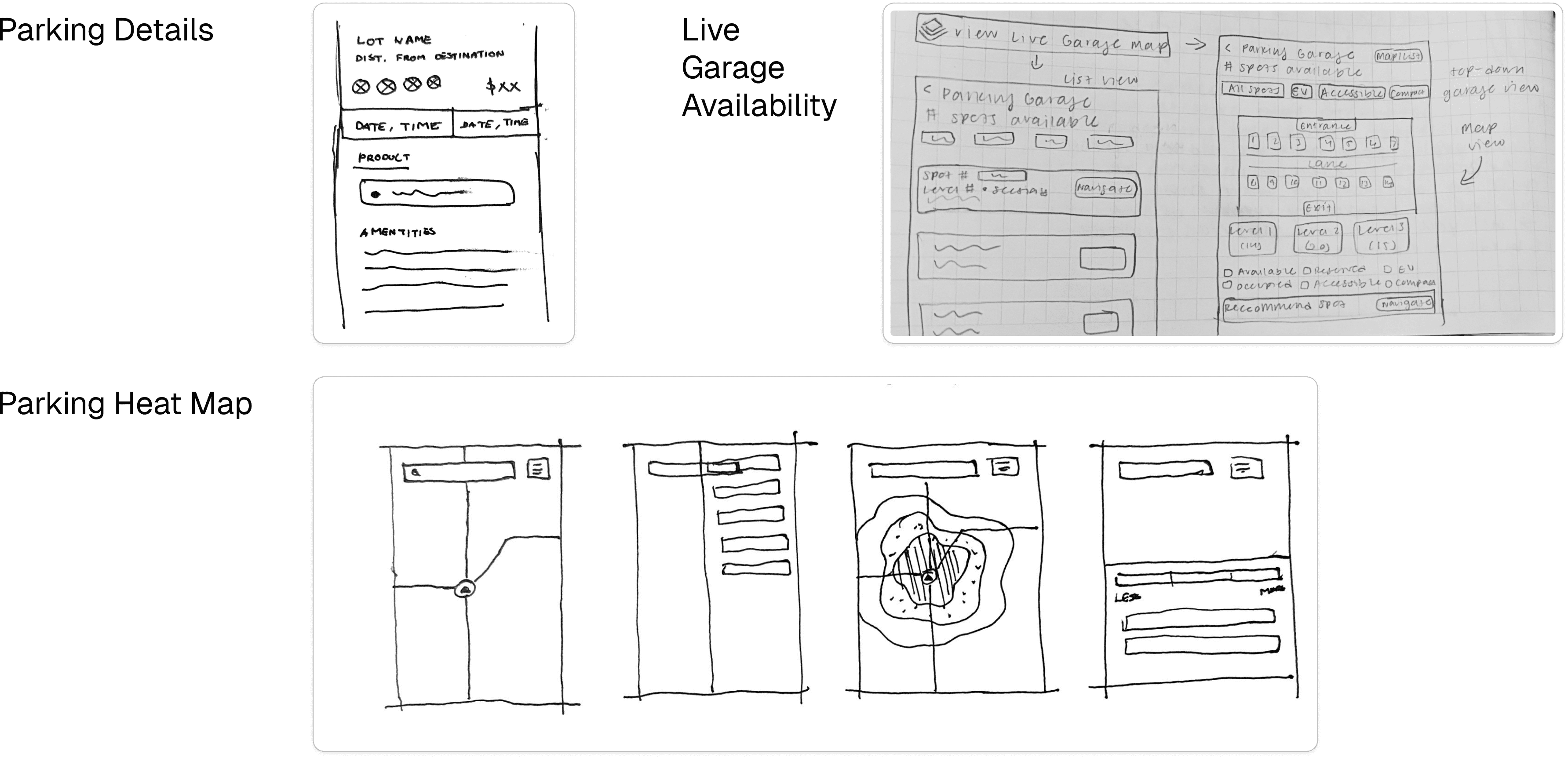
Pre-Parking Planning
Sketches around Pre-Parking Planning explored how we might surface key parking information earlier in the driver journey, allowing users to plan before arriving at their destination. Features we explored included parking details, live garage availability, and a parking heat map.
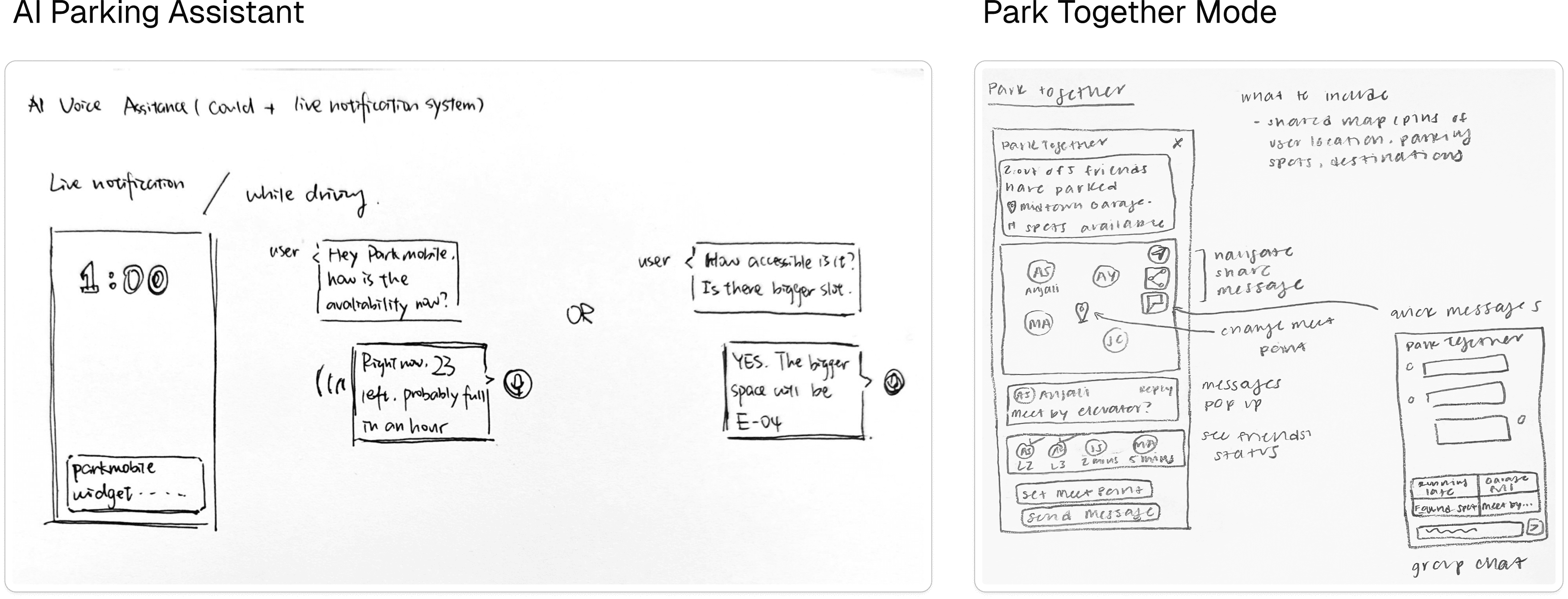
Parking Companions
Sketches for Parking Companions explored how parking could become a shared experience rather than an individual task. Concepts included an AI parking Assistant that lets drivers ask about real-time availability while driving, and a Park Together mode that helps friends and family coordinate parking and arrival at shared destinations.
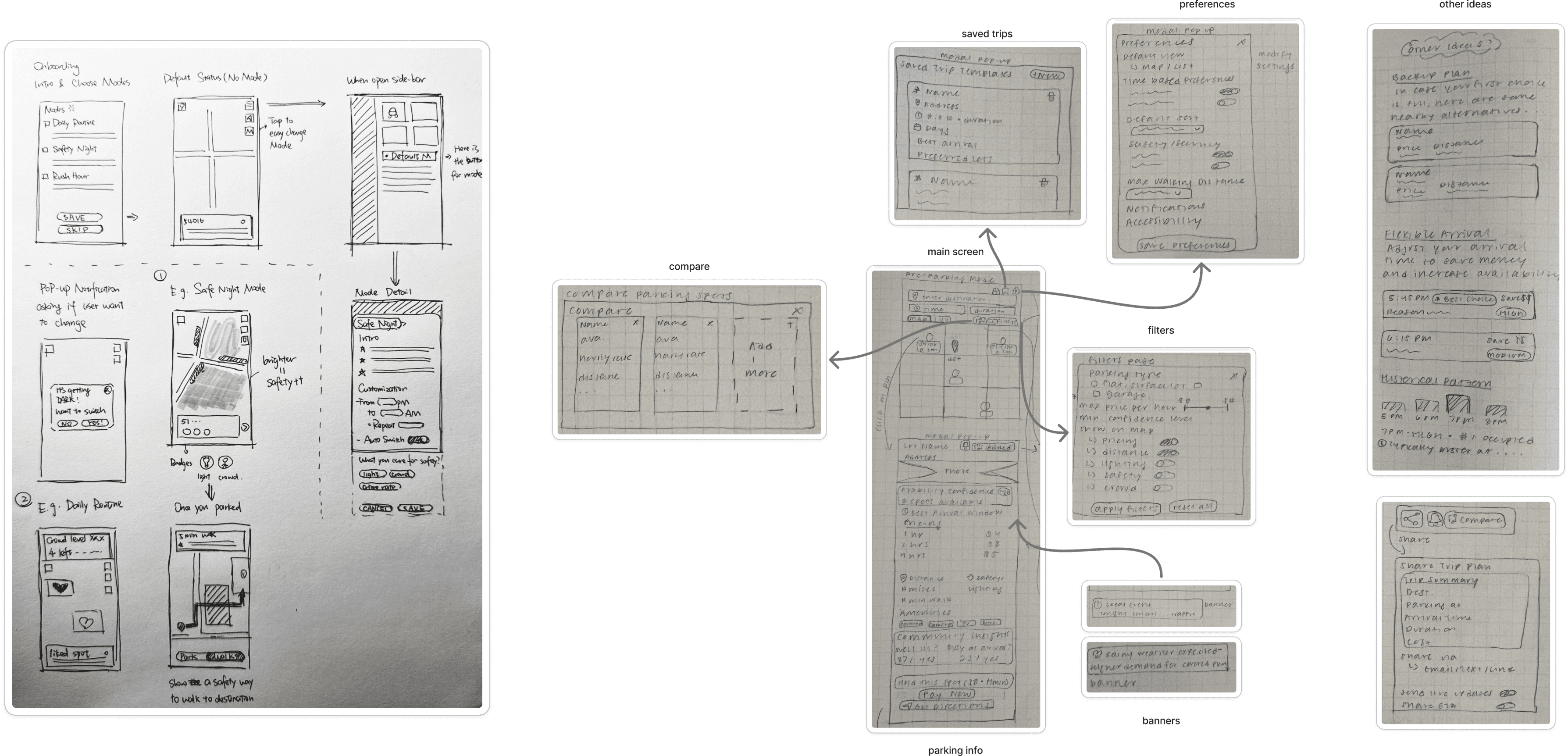
Adaptive Parking Modes
We explored Adaptive Parking Modes based on a key research insight: situational and emotional factors—such as time of day and stress—shape how drivers search for parking. To support these different contexts, we designed parking modes that adapt to scenarios like rush hour, nighttime driving, and daily commuting.
sketch feedback
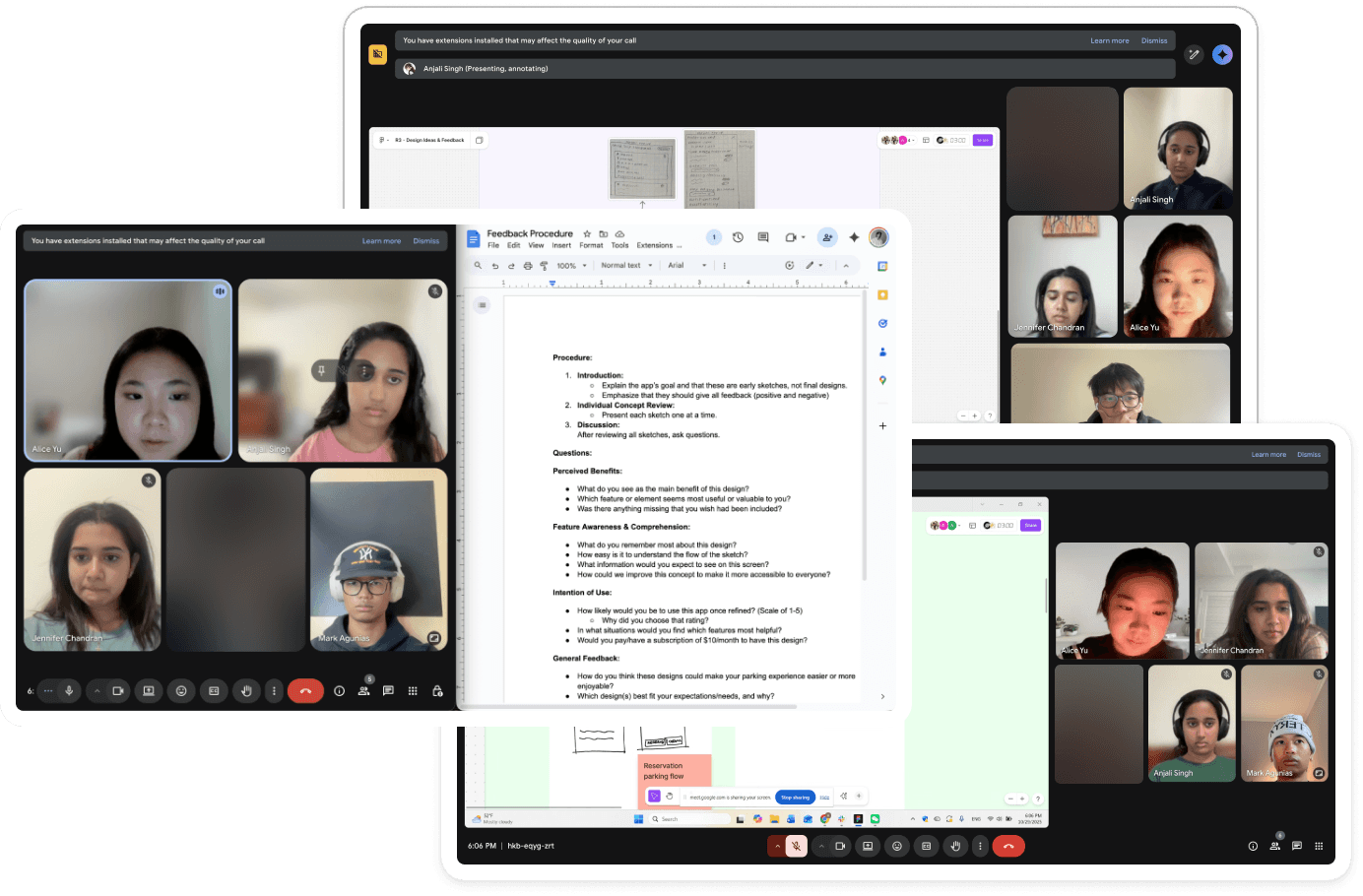
After completing sketches, the group conducted think-aloud sessions with drivers to gather feedback on our initial sketches. We found the following insights:
01

Reduce amount of parking modes
02

Enhance pre-parking planning and parking details
03

Continue developing parking intelligence
low-fi
Sketches were then transitioned into initial wireframes, where we used our sketches feedback as a foundation.
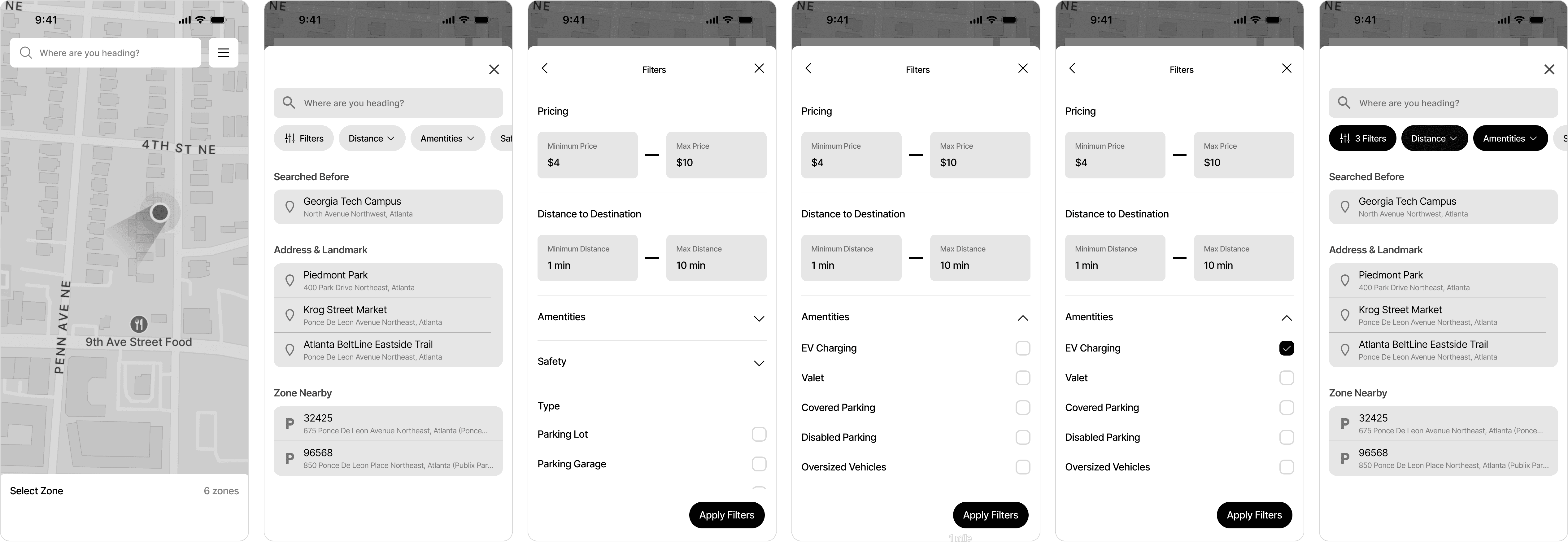
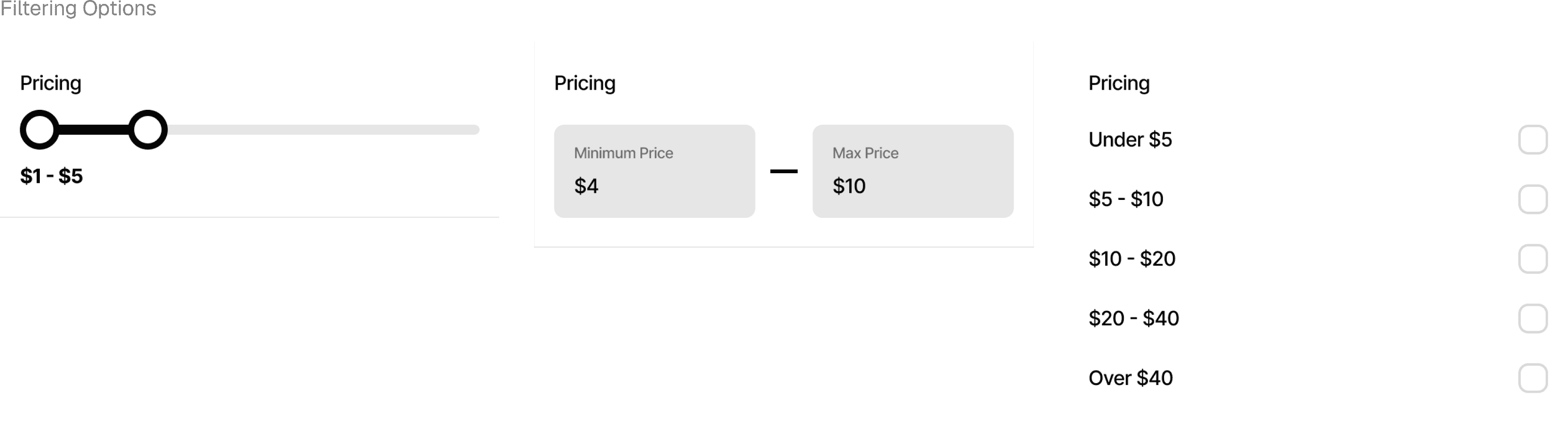
Parking Search & Filtering
Leading the design of parking search and filtering, I explored ways for drivers to refine results based on their preferences. I experimented with different interactions for filtering, including sliders, checkboxes, and input fields. I initially went with an input-based price filter, which we later evaluated through testing.
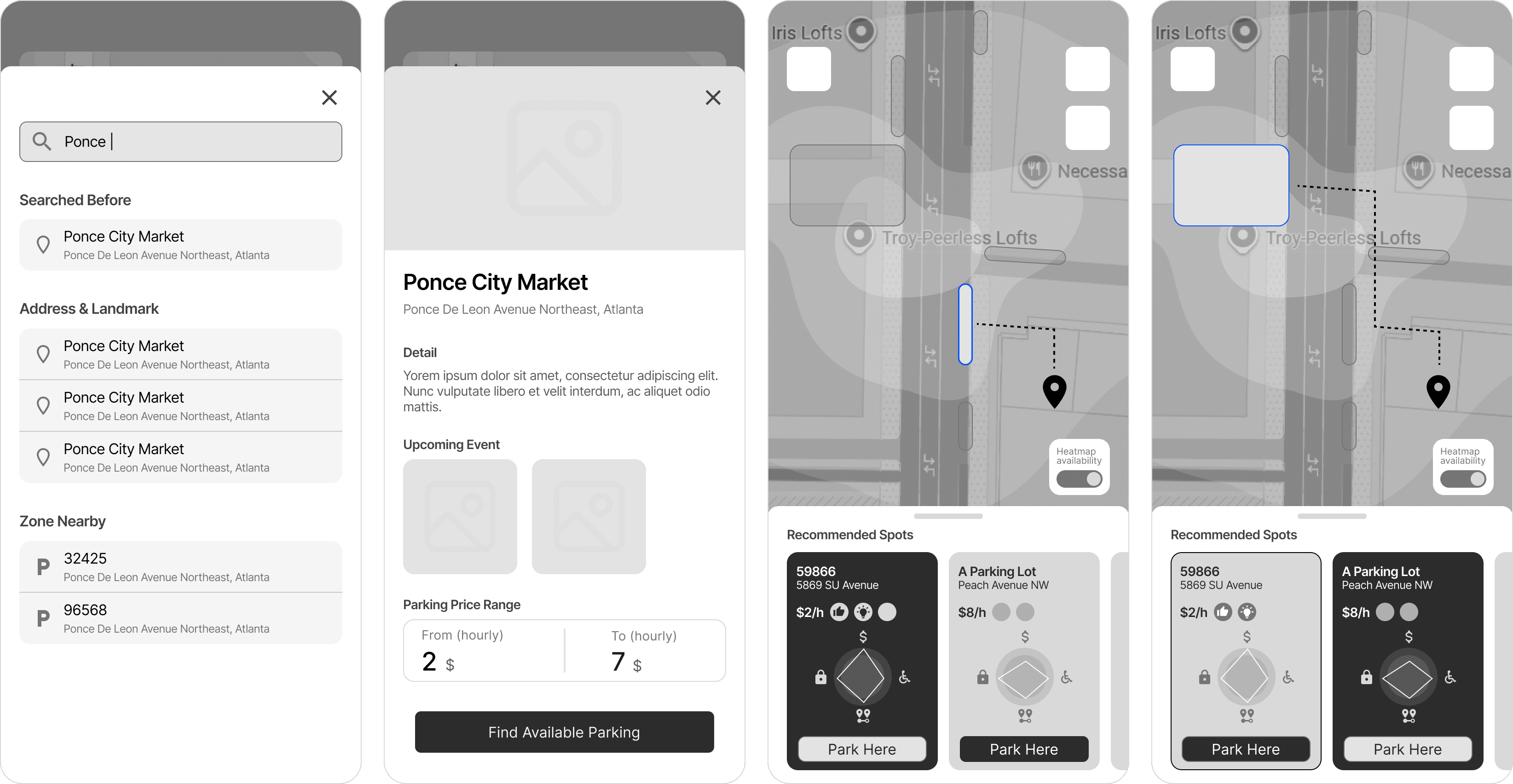
Parking Heat Map & Visualizations
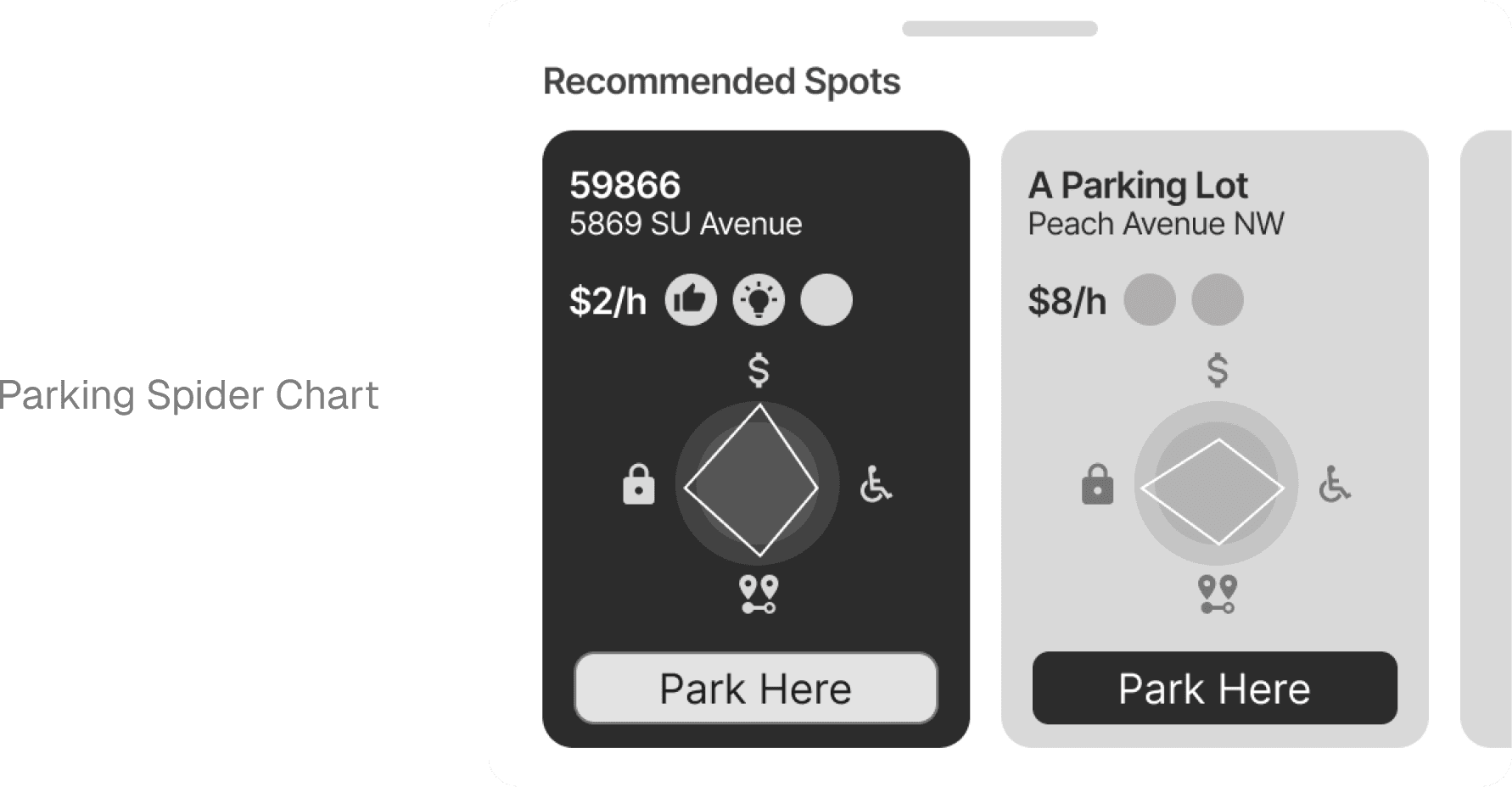
The parking heat map helps drivers quickly understand parking availability in a given area. To support deeper comparison, we also explored a Parking Spider Chart, allowing users to evaluate multiple parking options across key factors and quickly identify which spot best fits their needs.
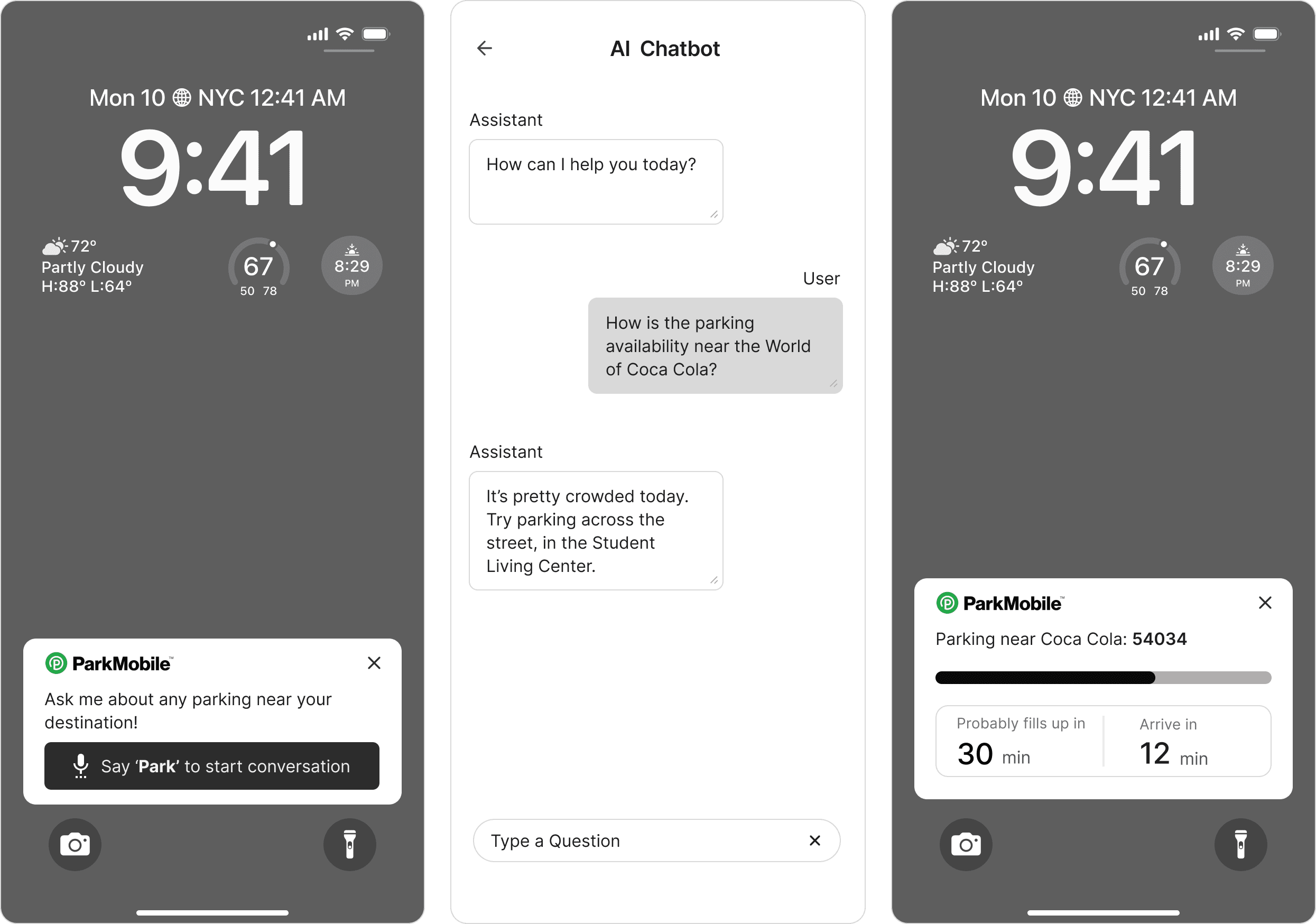
AI Parking Assistant
We continued developing the AI Parking Assistant, introducing a conversational chat interface and a contextual home screen notification that surfaces parking insights during a driver’s journey.
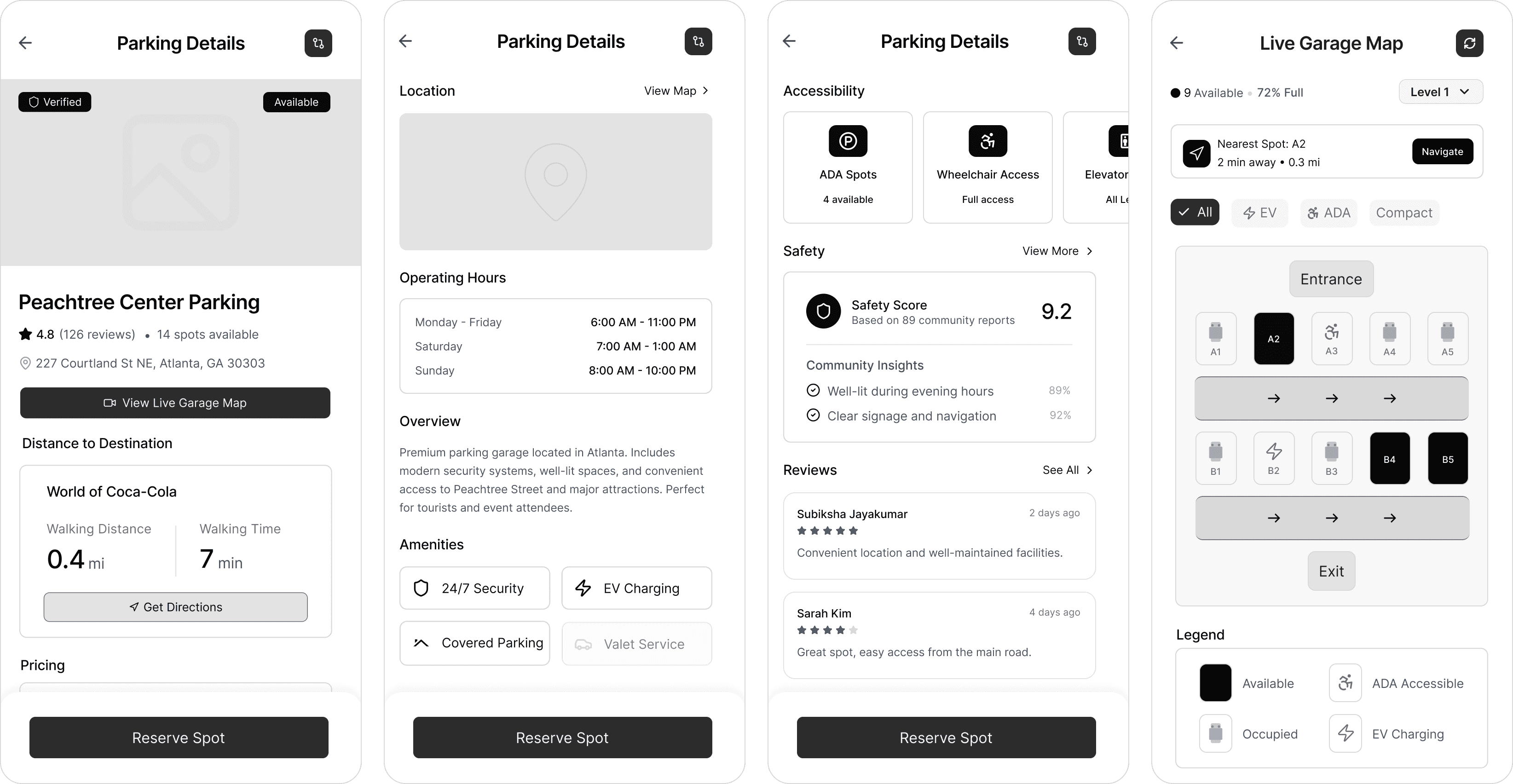
Parking Details & Live Garage Availability
Initial wireframes for parking details and live garage availability focused on providing concise information about amenities, accessibility, and real-time garage availability to help drivers quickly evaluate parking options.
low-fi feedback
After completing our initial wireframes, the group conducted think-aloud sessions with drivers to gather feedback. These were the biggest changes we made based on feedback:
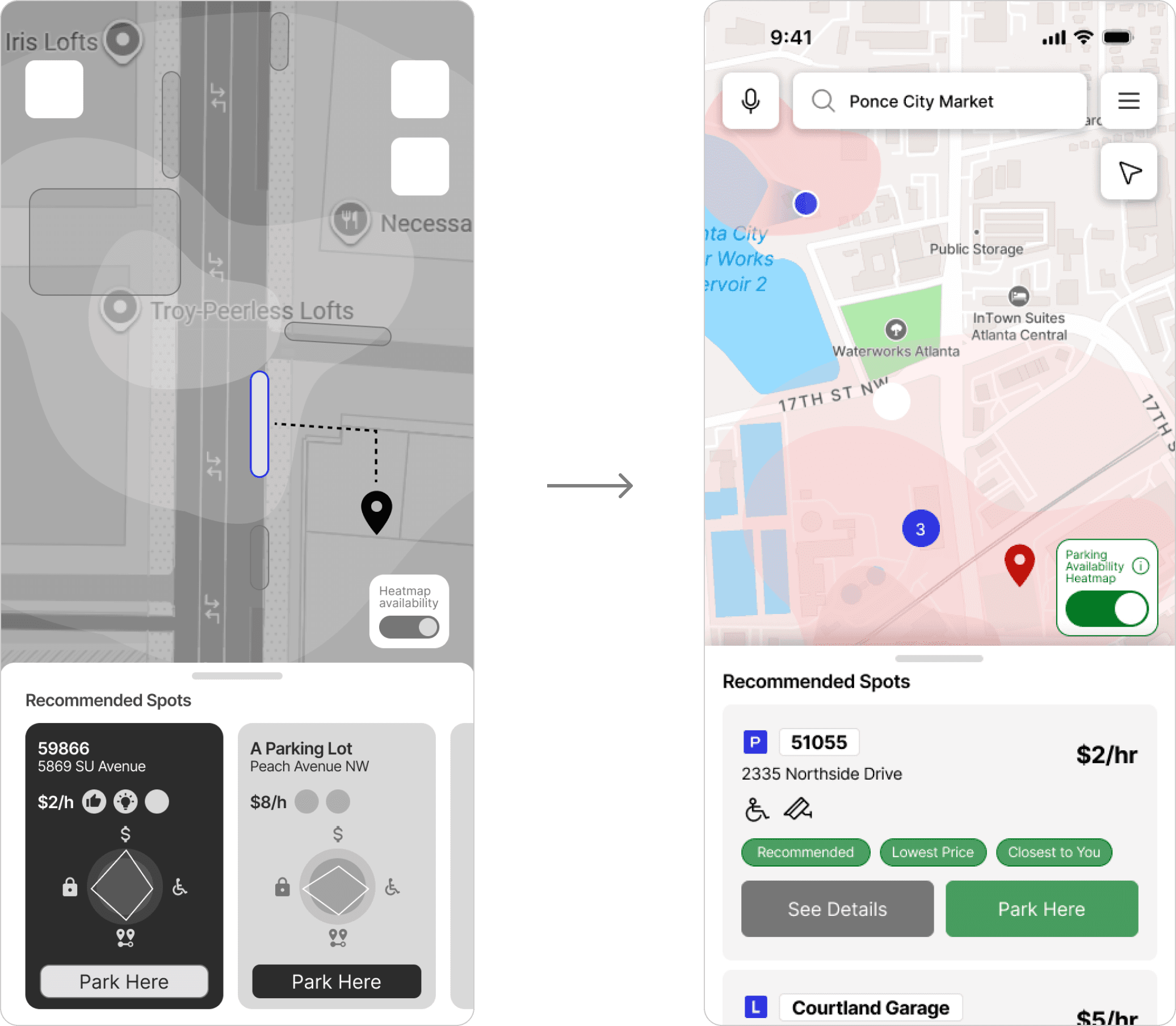
Simplifying Parking Visualizations
Users found the parking spider chart to be too difficult and complex to understand at first glance. Moving away from the chart, we redesigned the parking location card with a focus on scannability and simplicity.
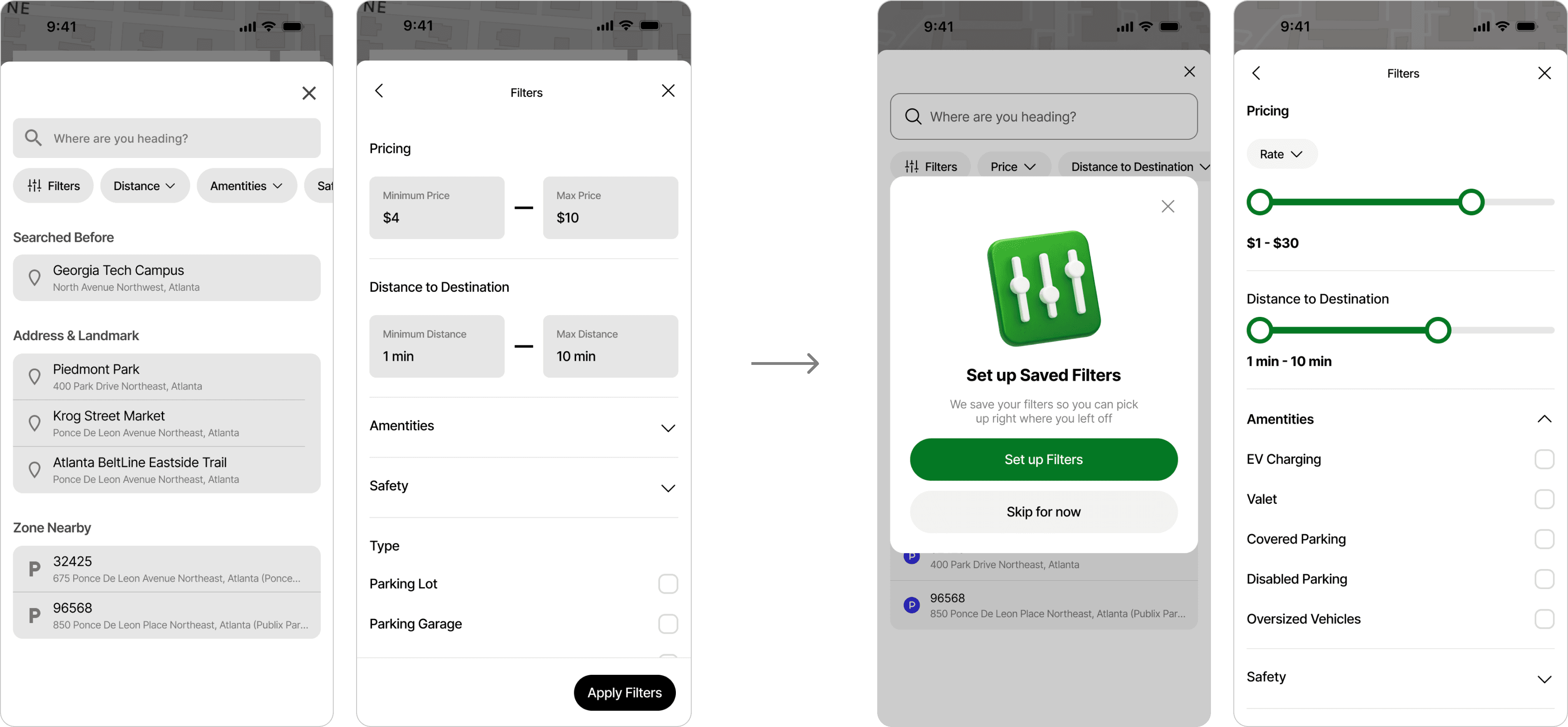
Improved Search + Customizability
In our testing, we found users preferred a slider input rather than a text box input for quicker inputs. In addition, users wanted to be able to save their filters for future use.
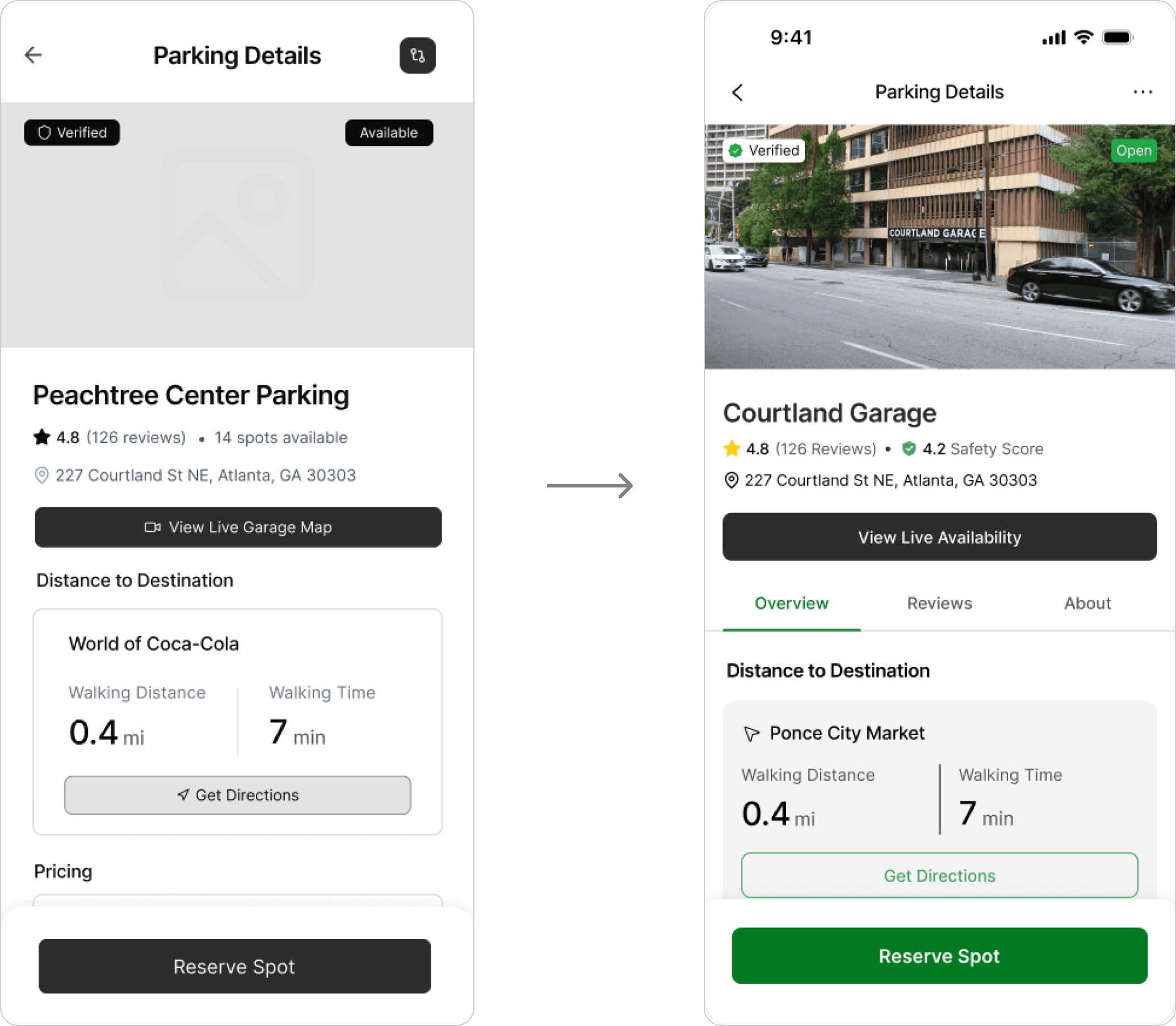
Improving Visual Hierarchy
Throughout parking details and live garage availability, there were concerns around text and buttons that felt like they were competing with one another. In our next iteration, we focused on improving visual hierarchy.
leveraging ai as a prototyper
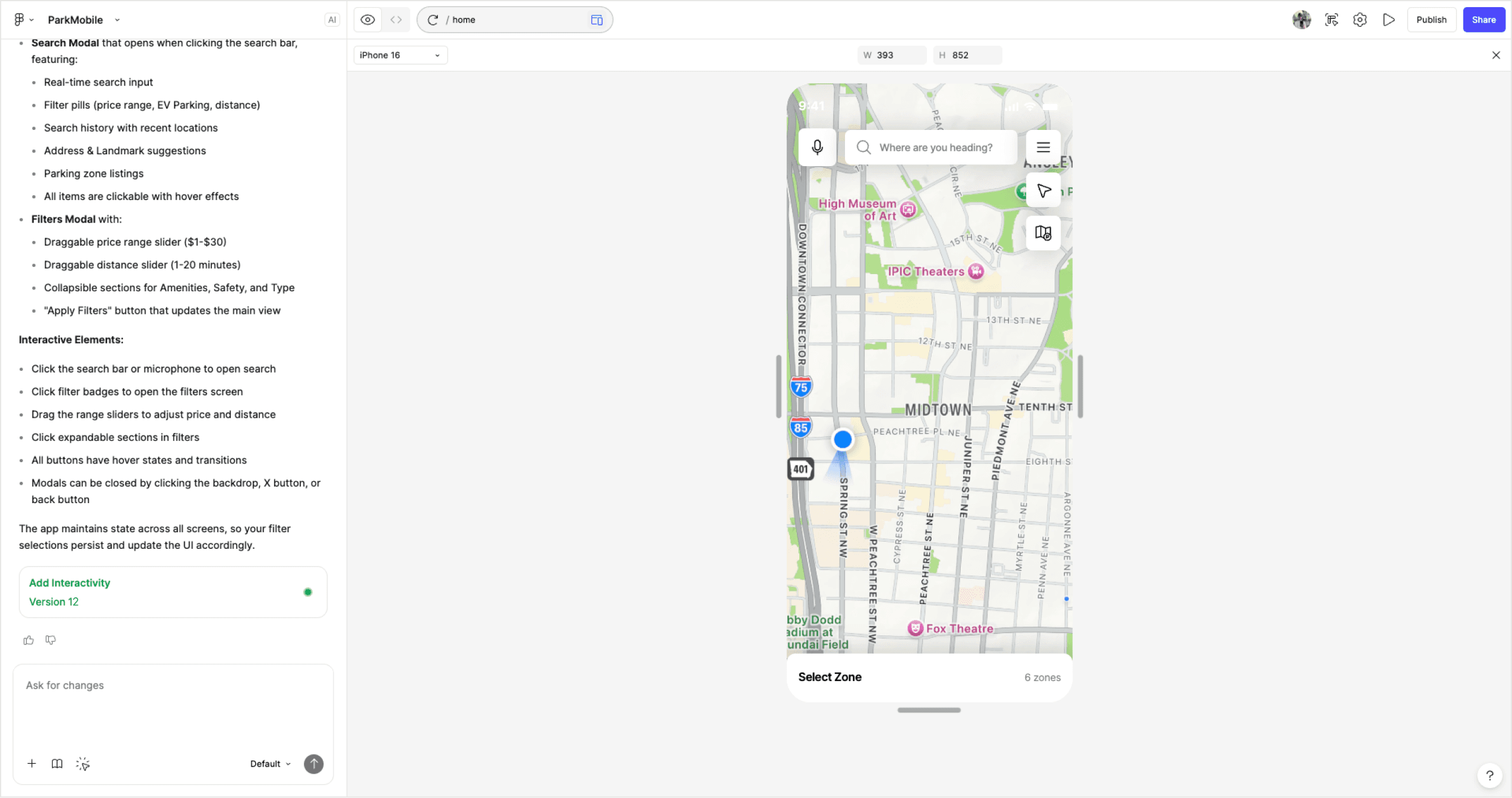
Throughout our prototyping process, we utilized AI design tools like Figma Make that allowed us to increased our speed and get prototypes the hands of users quicker. It also allowed us to add more complex interactions like map interactions - a task that would take much longer with manual prototyping.
The Solution
the solution
Parking Search + Filtering
Drivers can search for parking and filter based on price, distance to destination, amenities, and more.
Parking Map
Drivers can view parking availability in a given area with the heat map. In addition, drivers are able to view distance to final destination from their parking location.
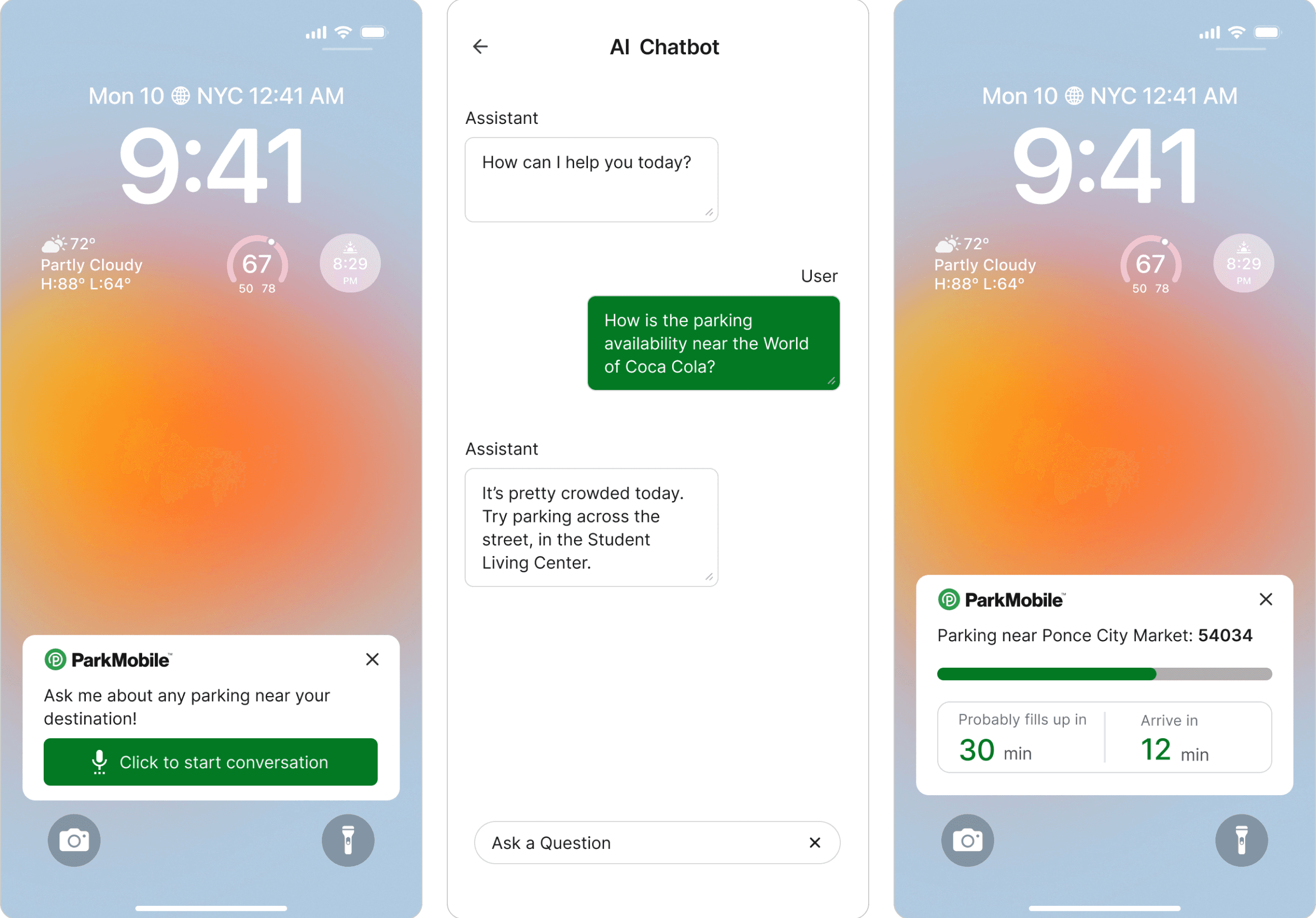
AI Parking Assistant
While driving, users can interact with an AI voice assistant and home-screen notifications for parking information on their intended destination.
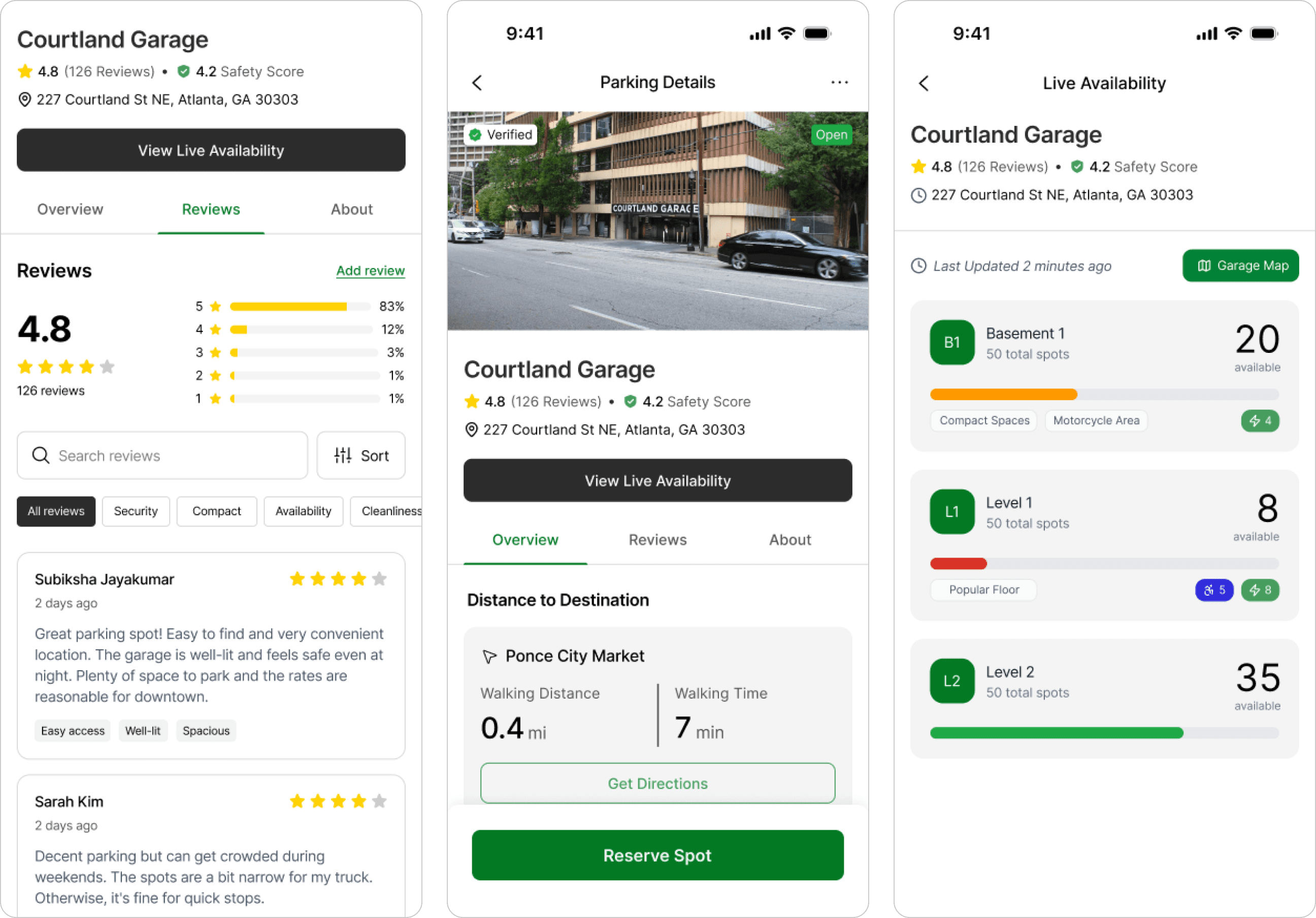
Parking Details
Drivers can receive additional information on parking such as reviews, safety, amenities, accessibility details, and spot availability.
Evaluations
Evaluations
After prototyping was completed, we conducted further evaluations through heuristic evaluations and usability testing. Heuristic evaluations were completed using the 10 Usability Heuristics with industry designers from ParkMobile and elsewhere. Usability testing was completed with four users.
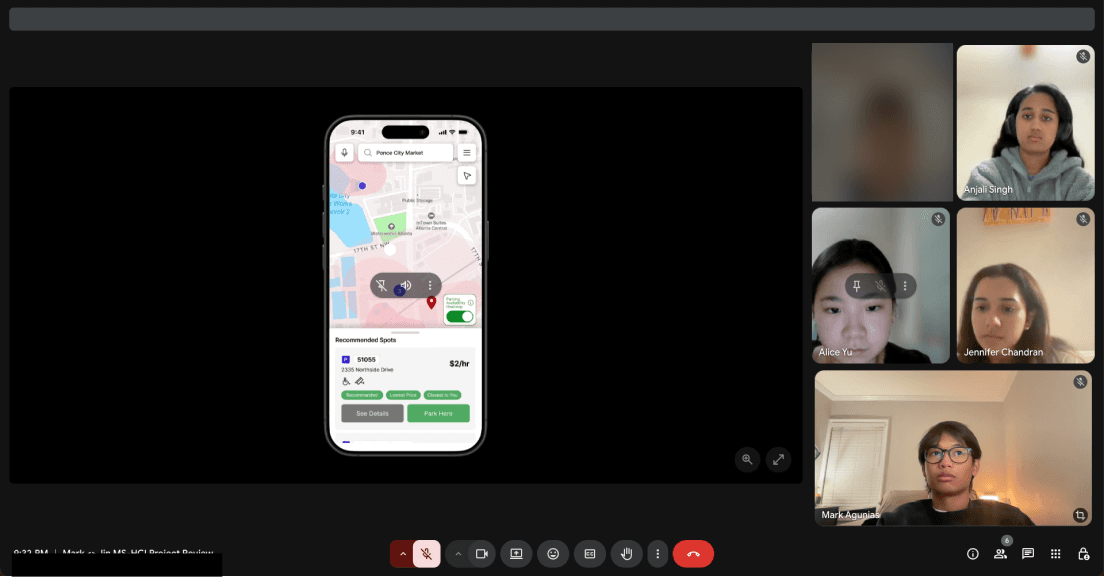

Heuristic Evaluations
Conducted 3 sessions with industry designers from ParkMobile
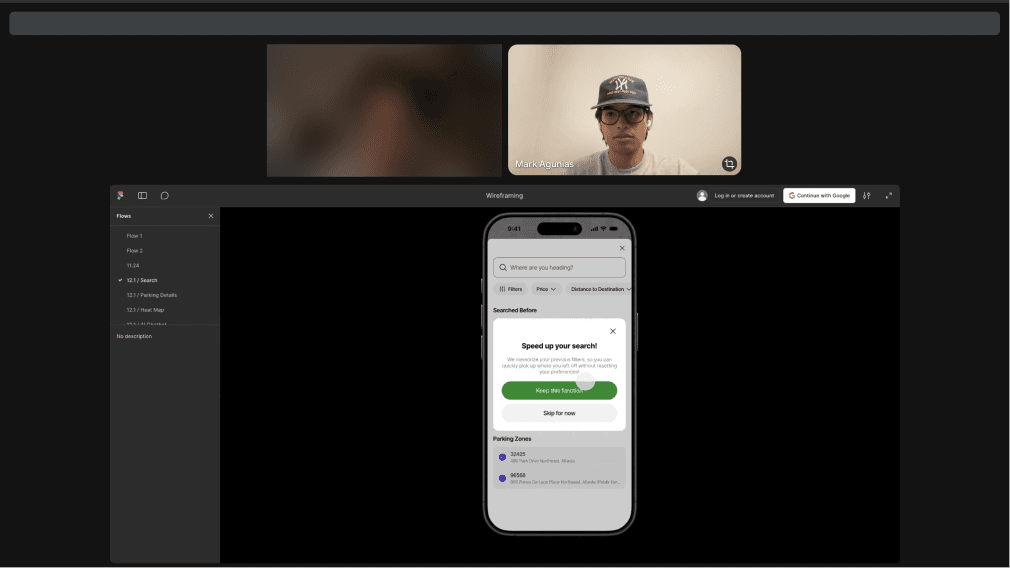

Usability Testing
Conducted 4 think aloud sessions with urban drivers
Evaluation findings
From these evaluations, we found the following insights into our proposed solution.
01

Parking detail pages were considered organized and helpful
02

Parking filtering felt familiar and intuitive
03
Potential in parking intelligence
In addition, there were still areas for improvement ->
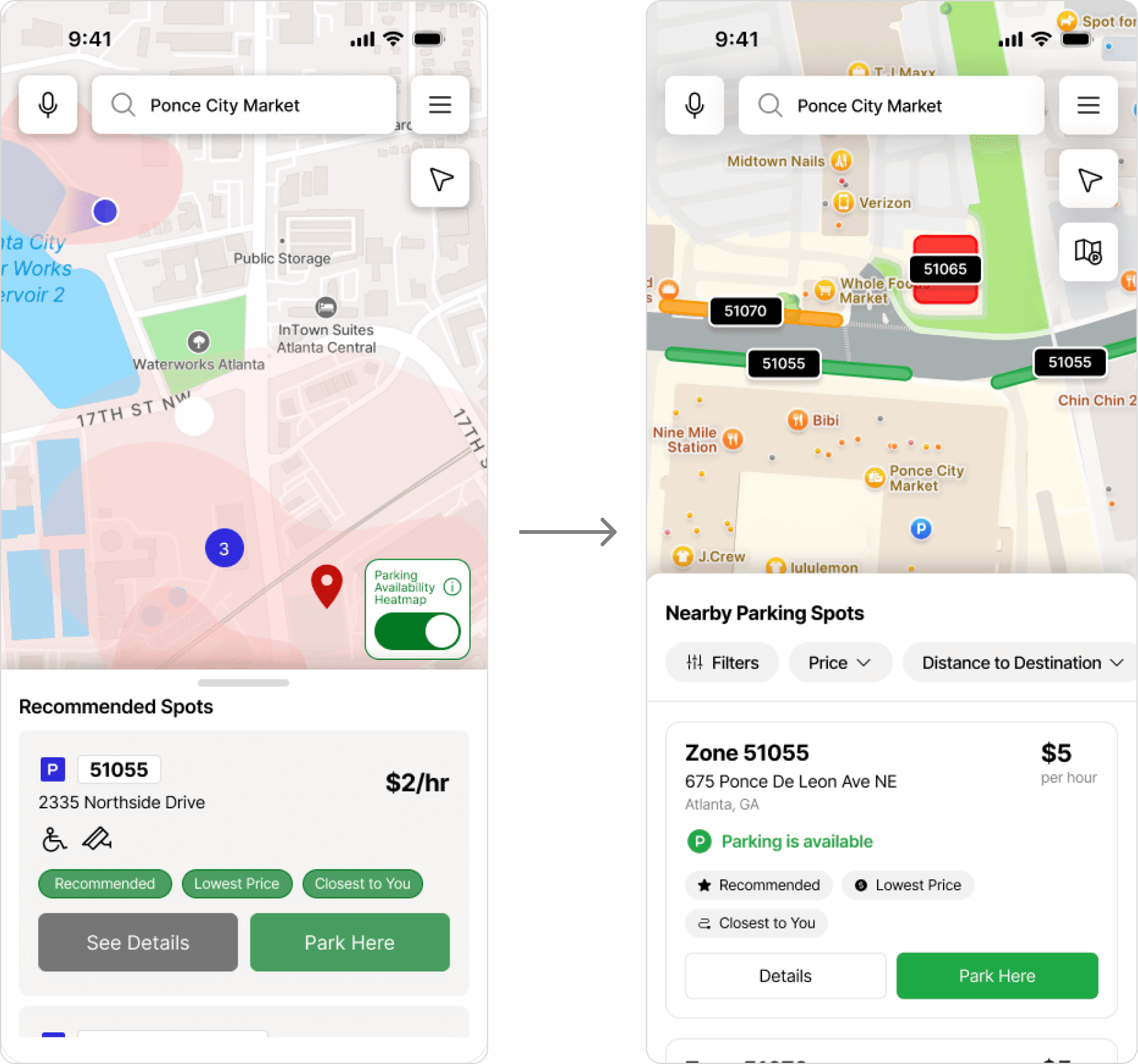
Parking availability visuals still being misinterpreted
Users were still misinterpreting the heat map where they believed more red areas to be more parking congestion. As such, we completely moved away from the heat map and towards a simplified visual for parking availability, where now individual parking zones highlight how available parking is based on a green to red color scale.
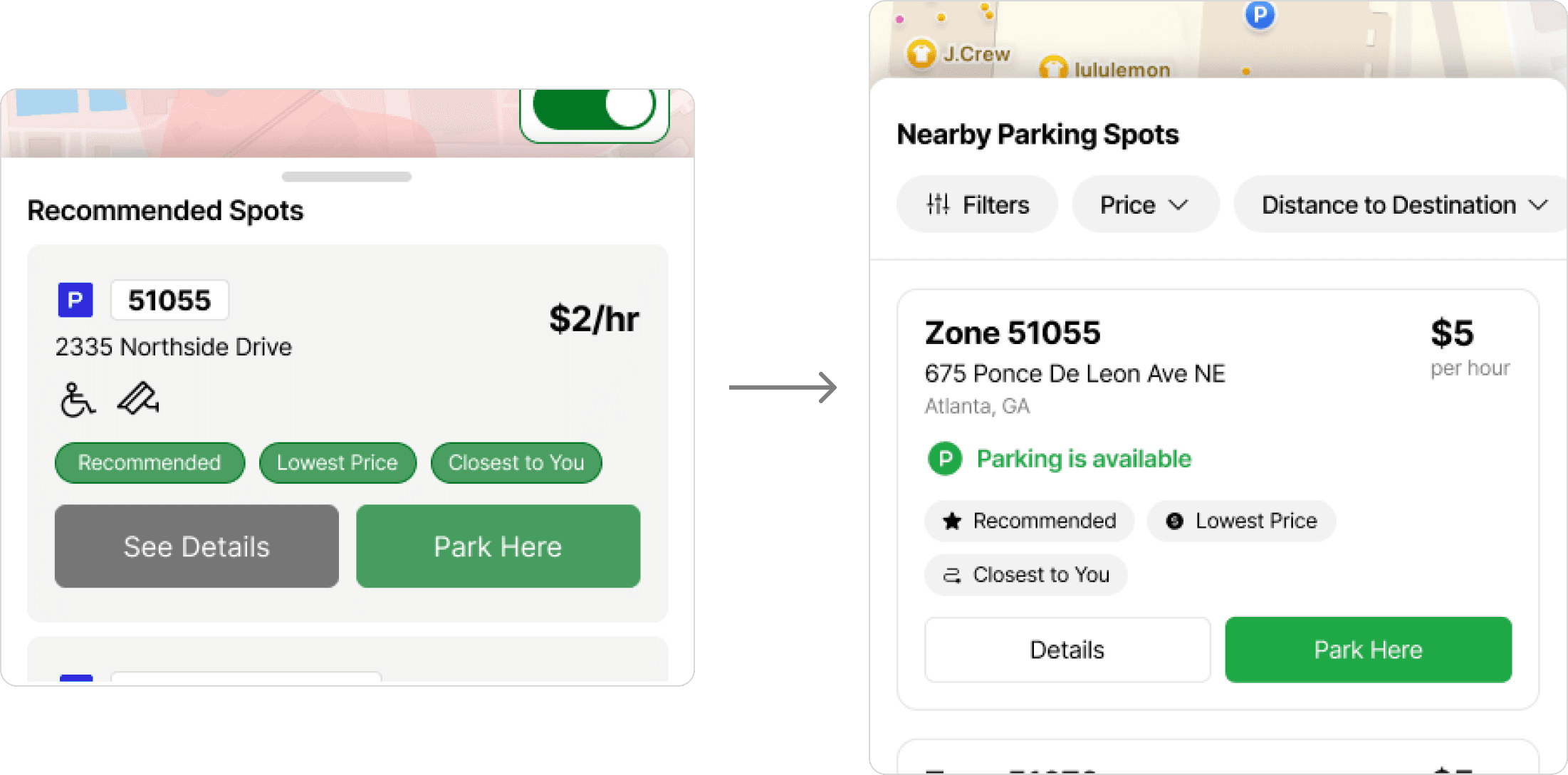
Quicker access to filters
Instead of having to go back and forth between the search bar and map to adjust filters, users wanted to see filters on the map for quicker filter adjustments.
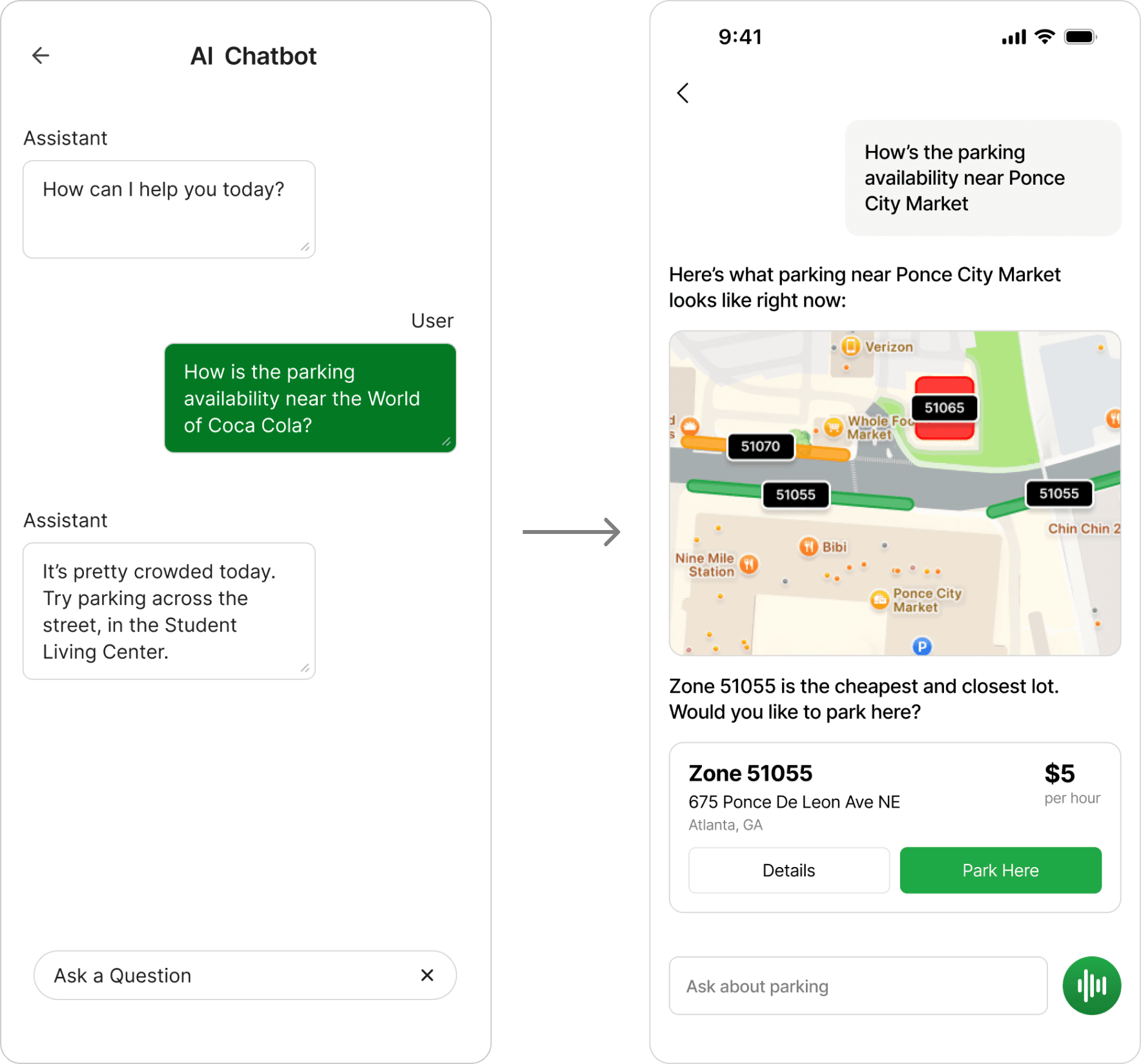
Users want more actionable intelligence
Rather than stagnant, text-heavy chats, users wanted more actionable intelligence that will provide and visualize parking availability.
Reflection
takeaways
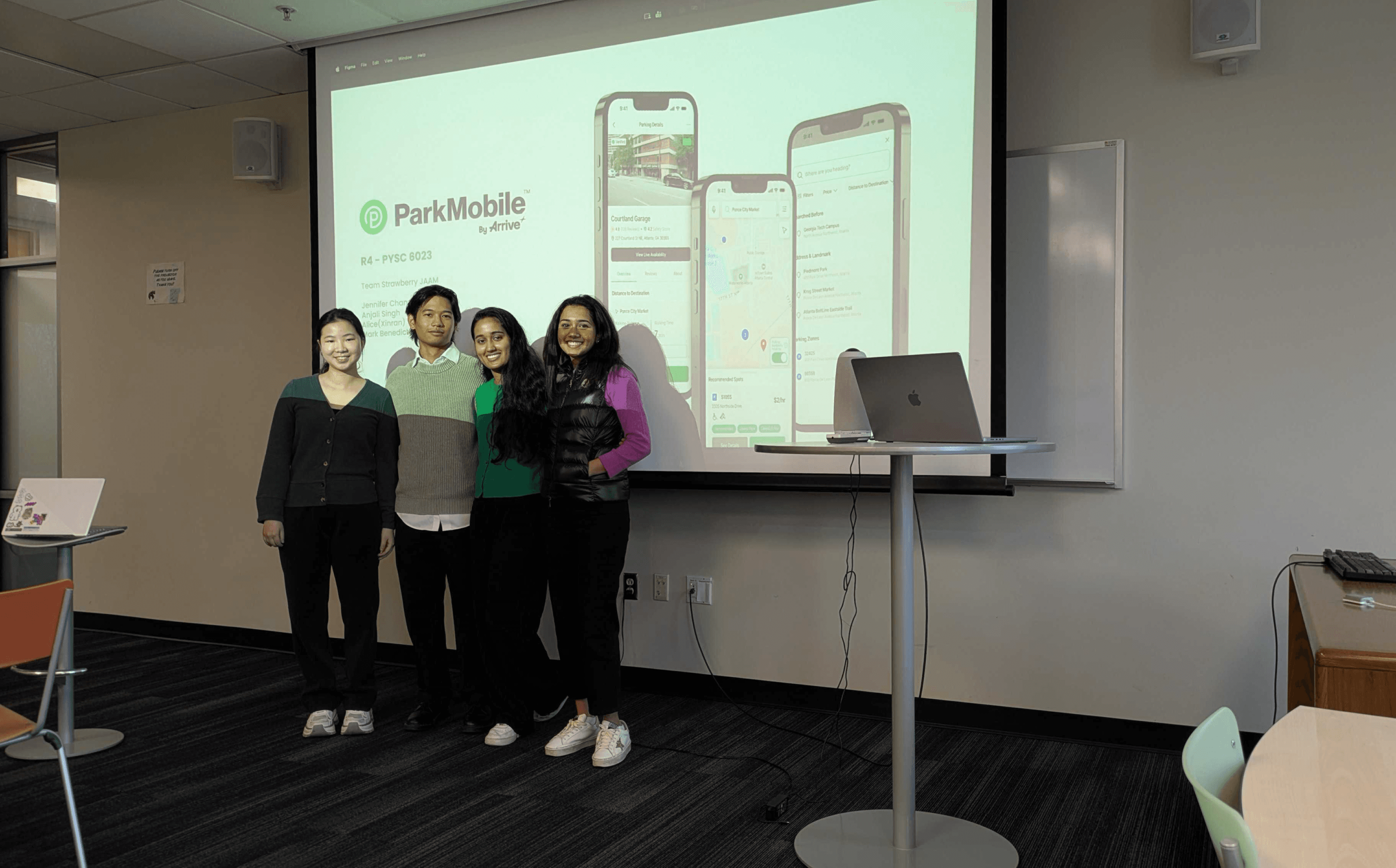
We were able to present our project to designers on the ParkMobile team and other stakeholders. Along with the valuable feedback, there were a couple takeaways I had.

Carrying out an end-to-end research plan
This was the most comprehensive research plan I've been a part of. From interviewing users to dissecting competitor apps, the research the group conducted yielded a ton of data points that need to be further analyzed.

Taking ownership
Work within the group was split based on features. Focusing on one particular feature which in this case were the parking search and filtering allowed me to really take ownership of the feature.
given more time
In addition, there are a couple things I would've done differently or would like to work on more if given more time.

Implement feedback
The biggest next step if given more time would be to implement feedback received when testing our final prototype.

Explore more directions
While we created several versions for features such as filtering, I would've liked to have dived deeper into what other directions could have looked like for features such as parking visualizations.

Meet users in the parking environment
Our research process involved gathering insights from users removed from the parking environment. I would be interested in what we could've learned if we had met users just right after parking or in the parking environment.